The short answer
Your marketing funnel is the path a client takes from first finding your business to booking you.
A practical LitBooked funnel is:
- Discover
- Explore
- Trust
- Enquire
- Consider
- Follow up
- Book
Each step has a different job.
Discover: get found by the right people.
Explore: give them a reason to learn more.
Trust: prove you can deliver.
Enquire: make contacting you easy.
Consider: help them understand what you recommend and why it's worth it.
Follow up: keep the conversation moving.
Book: make the final yes easy.
Different marketing jobs belong to different steps.
Google may bring discovery.
Your photos and videos may create interest.
Reviews may build trust.
Your website may bring enquiries.
Your quote may sway the decision.
Follow up may win back clients who went quiet.
And your booking process closes the deal.
An event business can have a good website, strong Instagram posts, dozens of Google reviews and great photos, and still have a patchy booking calendar.
Why?
Because marketing isn't only about getting noticed.
A client goes through several steps before they book you.
They need to:
Find your business → get interested → trust your work → enquire → weigh up your quote → hear back from you → book.
Those steps are your marketing funnel. In plain words, a marketing funnel is the steps a client goes through, from first finding you to booking you. It's called a funnel because lots of people start at the top and fewer reach the end.
Whether you're a DJ, an AV company, a tent rental company or a wedding vendor, knowing your funnel turns "What marketing should we do?" into a far more useful question:
"Where are clients getting stuck?"
The LitBooked booking funnel
Here's the full system:
- Discover
- Explore
- Trust
- Enquire
- Consider
- Follow up
- Book
Think of it as steps that each ask a bit more of the client.
A couple searching "wedding decor ideas" isn't ready to contact anyone yet.
Someone searching "wedding DJ near me" may be much closer.
A planner who has sent you their date, venue and guest count and asked for a quote is closer still.
That's why treating every visitor the same doesn't work.
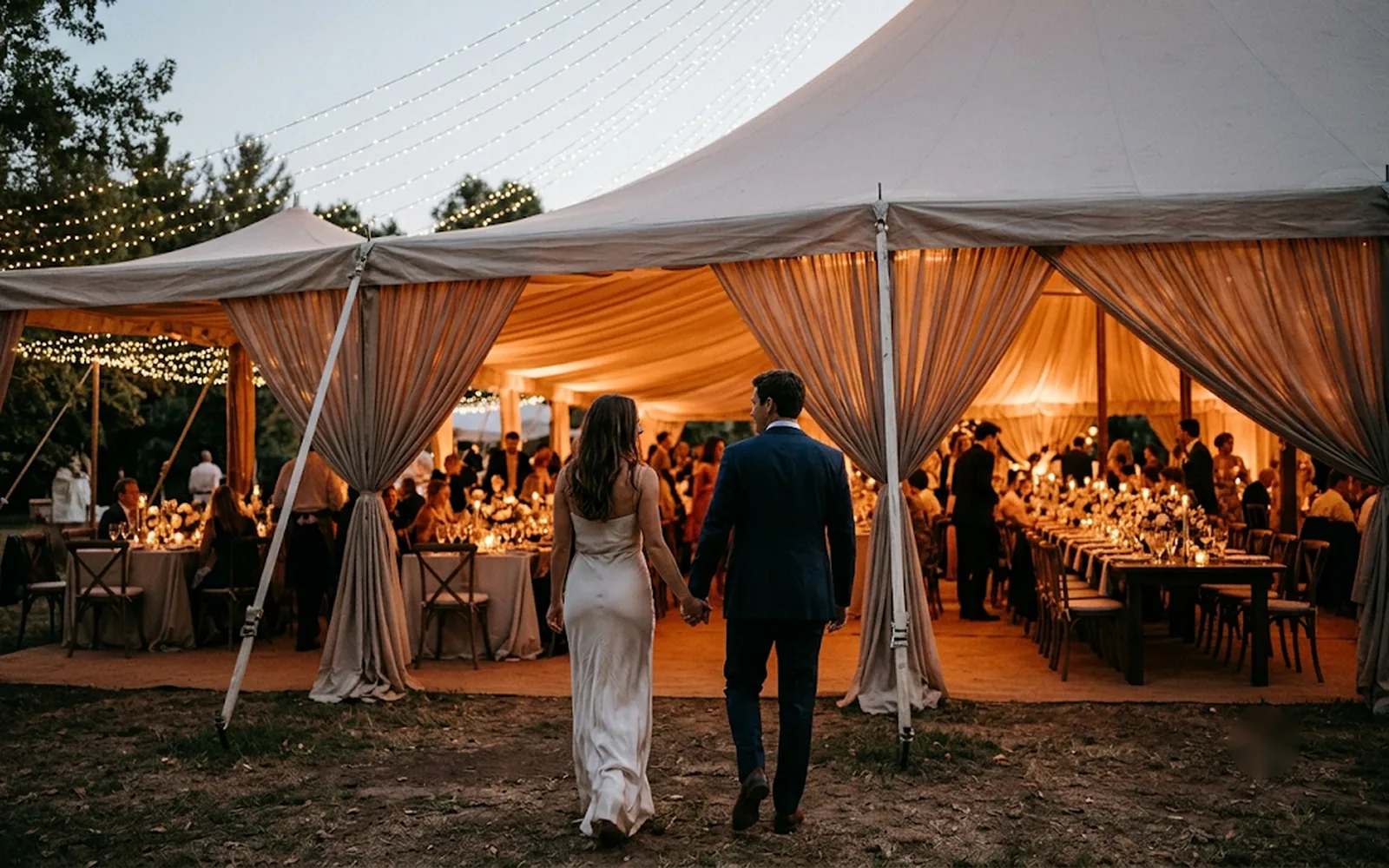
Why event businesses need a funnel
Without a funnel, marketing often turns into a pile of separate jobs.
You post on Instagram.
You update your website.
You ask for reviews.
You contact venues.
You write a blog post.
You get a few enquiries.
You can't see how any of it connects. A funnel gives every job a purpose.
| Funnel step | What the client is asking | Your marketing job |
| Discover | "Who can help me?" | Get found |
| Explore | "Could they be right for me?" | Create interest |
| Trust | "Can I trust them?" | Show proof |
| Enquire | "How do I contact them?" | Get them to act |
| Consider | "Is this the right fit?" | Build confidence |
| Follow up | "Should I go ahead?" | Ease their doubts |
| Book | "How do I lock in the date?" | Clear the way |
The goal isn't to push everyone through fast. It's to give people the right information at the right step.
Step 1, discover: get in front of the right people
The funnel starts before someone knows your business exists.
Clients can find an event business through:
- Google search
- Google Maps
- Wedding searches
- Venue searches
- Social media
- Referrals
- Planners
- Venues
- Past clients
- Other vendors you work with
- Helpful content about events
But being found only matters if it's the right people.
A corporate planner booking sound and staging for a conference wants something different from a couple booking a wedding photo booth.
So where you show up should match the events and clients you want.
Useful things to have at this step
- Service pages
- Location pages (a page for each city or area you serve)
- Your Google Business Profile (the box with your map, photos and reviews that shows up on Google)
- SEO content (articles that show up in Google)
- Pages about venues you've worked at
- Pinterest pins
- Social posts
- Referral relationships
The question at this step: are the right people finding you?
Step 2, explore: give them a reason to keep looking
Being found doesn't mean you have their attention.
A client might land on your website and leave in seconds.
They're trying to work out: "Could this business actually be right for my event?" This is where the way you show your work matters.
Strong things to have at this step:
- Photo and video galleries
- Before and after examples (the empty tent or ballroom, then the finished room)
- Work at specific venues
- Clear explanations of your services
- Pages for each type of event (weddings, corporate, parties)
- Ideas and inspiration
- Helpful articles
- Project examples
Your content should help people picture what you could do for their event.
A gallery of great photos is useful. A gallery that says what you did, why and how it turned out is much stronger.
Step 3, trust: give them reasons to believe you can deliver
Most event services are bought before the client sees the result. They can't inspect it first, like a product on a shelf.
They're trusting you with an important day. That's a big ask.
Clients may want to know:
Have you done events like mine?
Have you worked at this venue?
Do past clients recommend you?
Are you professional?
Will you show up prepared?
Can you work with the venue?
Will the finished setup actually look like the photos?
Your proof should answer these worries with:
- Relevant work: show events like the one the client is planning.
- Reviews: show what it's like to work with you.
- Venue experience: show you know spaces they recognize.
- Process: explain how planning, load in, coordination and the day itself work.
- Focus: make it clear which events and services you specialize in.
The rule: don't ask clients to trust you before you've given them evidence.
Step 4, enquire: turn interest into a real lead
Sooner or later, the client needs to act.
That might mean:
- Asking for a quote
- Filling in an enquiry form
- Calling
- Booking a call
- Sending an email
- Asking a question
This is where many businesses lose people.
The client may be interested but still not know: what should I do next?
Your website should make that obvious.
A good enquiry path tells them:
What happens when I contact you?
What details should I send?
When will I hear back?
What happens after that?
You don't need complicated forms.
You need one clear next step with as few hurdles as possible.
Step 5, consider: help the client decide
An enquiry doesn't mean someone's ready to book.
Now they're weighing you up.
They may be comparing:
- Your business
- Another business that does what you do
- A vendor who bundles services, like a DJ who also brings lighting
- The venue's preferred vendor (a supplier the venue recommends)
- A bigger production company
- Cutting that part of the plan
- Doing it themselves
Your quote needs to answer:
What do you recommend?
Why does it suit my event?
What's included?
What will it do for the event?
Why does it cost what it costs?
A quote that only lists gear makes the client work out the value on their own.
A strong quote connects:
- What the client needs
- What you recommend
- What they'll get
- The price
That's a much easier decision to make.
Step 6, follow up: don't let good leads disappear
Not every client books right away. They may need to:
Talk it over with a partner.
Confirm the venue.
Get sign off from their company.
Compare quotes.
Settle their budget.
Decide what they actually need.
A useful follow up doesn't just say:
"Just checking in." Instead, it gives the client a reason to pick the conversation back up.
You might send:
- A relevant past event
- A clarification
- Another option
- An idea for their venue
- An answer to a question
- A reminder about the next planning step
The goal isn't to pressure anyone. It's to clear away the reasons they're still unsure.
Step 7, book: make the final step easy
Once the client has decided "Yes, we want you," they shouldn't hit any snags.
Make the process clear:
- Approve the quote
- Sign the agreement
- Pay the deposit
- Date locked in
- Planning starts
Your process may differ, but the client should know:
- How the date is secured
- What they need to sign
- What payment is needed
- What happens next
- When planning starts
The clearer the last step, the less room there is for second thoughts.
What a healthy funnel looks like
Imagine an event business gets:
1,000 relevant website visits ↓ 150 visitors who look around ↓ 40 enquiries ↓ 25 good leads ↓ 18 quotes ↓ 8 bookings
These numbers are only an illustration, not industry averages.
If it gets 1,000 visitors but only 5 enquiries, the website probably isn't turning visitors into enquiries.
If it gets 40 enquiries but only 3 bookings, the problem may be which leads it chases, its quotes, its follow up, how it explains price, or how it sells.
Without a funnel, these problems all look like:
"Marketing isn't working." With a funnel, you can ask:
"Which step is leaking?"
The most important funnel number isn't traffic
Traffic, the number of people visiting your website, is easy to celebrate.
But on its own it doesn't show if your marketing works.
Track how people move through the funnel:
| Step | What to measure |
| Discover | Showing up in Google and Maps, relevant visits |
| Explore | Visits where people look around, views of key pages |
| Trust | Gallery and service page views, reviews |
| Enquire | Number of enquiries |
| Consider | Good leads, calls booked, quotes sent |
| Follow up | Leads still open |
| Book | Confirmed bookings |
Then look for the biggest drop.
That's often more useful than trying to get more people in at the top.
The three funnel problems most event businesses have
Problem 1: not enough people come in
Not enough of the right people are finding you.
Focus on: SEO (showing up in Google searches), Google Maps, content, social media, Pinterest, venues, planners and referrals.
Problem 2: people come in but don't enquire
People see you but don't act.
Focus on: a clear website, photos and videos, proof, service pages, clear next step buttons and your enquiry process.
Problem 3: people enquire but don't book
You get enquiries but lose too many while they decide.
Focus on: how fast and how well you reply, the questions you ask, your quotes, how you explain price, proof, follow up and your booking process.
That's why "more traffic" isn't always the answer.
What this looks like for different event businesses
The funnel stays the same. What goes inside it changes.
DJ and entertainment company
Discover: "wedding DJ + city" • Explore: videos of the whole night • Trust: reviews • Enquire: date and needs • Consider: an entertainment package • Book: agreement and deposit
Event production or AV company
Discover: corporate event searches • Explore: production photos and videos • Trust: corporate examples • Enquire: event requirements • Consider: a production proposal • Book: agreement and planning
Tent and decor rental company
Discover: "tent rental + city" • Explore: tents set up at real events • Trust: reviews and venue examples • Enquire: date, guest count and site • Consider: a quote with a layout • Book: contract and deposit
Wedding vendor
Discover: wedding searches and venue referrals • Explore: wedding galleries • Trust: wedding reviews • Enquire: date and venue • Consider: a personal package • Book: contract and deposit
The shape stays the same. The client's questions change.
What most event businesses get wrong
They treat every visitor like a buyer
Someone reading "wedding decor ideas" may be researching. Someone searching "photo booth rental near me" may be ready to talk.
Better: match your content and your next step to where the person is.
They focus only on the top of the funnel
More traffic doesn't fix a broken enquiry process.
Better: fix the weakest step first.
They put everything into social media
Social media can help people find you and trust you, but it isn't a full funnel on its own.
Better: link your social posts to your website, proof, enquiry process and booking steps.
They stop marketing once the lead arrives
The funnel doesn't end at the enquiry form.
Better: treat your reply, your quote and your follow up as part of marketing.
They don't track the journey
Without tracking each step, every problem looks like a traffic problem.
Better: track how people move from finding you to booking you.
What probably won't work
"We just need more traffic." More visitors won't bring more bookings if the middle or end of your funnel is weak.
Posting more often. More posts may help people find you, but only if they reach the right people and lead to a useful next step.
Sending every visitor to "Contact us". Different clients need different information before they're ready to enquire.
Building a complicated funnel. You don't need ten software tools and dozens of automatic emails. A clear website, useful content, good proof, an easy enquiry process and steady follow up can be enough.
What does work: building the funnel around client questions. The strongest funnel answers the questions a client naturally has at every step.
Find your funnel bottleneck
Use this quick check.
If you're not being found:
Visibility problem. Look at SEO, Google Maps, content, partnerships, social media and referrals.
If people visit but leave:
Relevance or trust problem. Look at your wording, photos, service pages and proof.
If people look around but don't enquire:
Conversion problem: visitors aren't turning into enquiries. Look at your buttons, your enquiry form and how clear the next step is.
If enquiries don't turn into quotes:
Qualifying or reply problem. Look at your first reply and the questions you ask.
If quotes don't turn into bookings:
Decision problem. Look at your recommendation, quote, proof, how you explain price and your follow up.
If bookings come and go:
Pipeline problem: not enough new leads come in steadily. Look at whether enough reliable sources feed the top of your funnel.
Build your funnel in 30 days
You don't need to rebuild everything at once.
Week 1: map the funnel you have
Write down:
Where do people find you?
Where do they go next?
How do they enquire?
How do you reply?
How do you quote?
How do you follow up?
How do they book?
Find the biggest gap.
Week 2: improve discovery and trust
Improve:
- Google Business Profile
- Key service pages
- Photos and videos
- Reviews
- One or two strong, helpful articles
- Examples from venues and past events
Week 3: improve conversion
Review:
- Enquiry form
- Buttons and next steps
- First reply
- The questions you ask
- Quote
- Booking instructions
Remove anything that gets in the way.
Week 4: measure the funnel
Track:
- Found you
- Enquiry
- Good lead
- Quote
- Booking
You don't need perfect website tracking.
You need enough information to see where you're losing people.
What should you work on first?
Start with your weakest step.
Not enough people finding you? Work on discovery.
People find you but don't look around? Work on relevance and trust.
People look around but don't enquire? Work on conversion.
You get enquiries but send few quotes? Work on your reply and on qualifying leads.
You send quotes but don't book enough? Work on your quotes and follow up.
You book well but the calendar is patchy? Work on more reliable ways for the right people to find you.
This stops the common mistake of throwing more marketing at a problem that sits somewhere else in the funnel.
What is one extra booking worth to you?
Move the sliders to match your business. It only takes a few seconds, and nothing you enter leaves this page.
Bookings a month6
Booking money a month$9,000
One extra booking a month is worth$18,000 a year
If just one more enquiry in 10 booked, that would be 2 more bookings a month.
Get your free checkQuestions
What is a marketing funnel for an event business?
It's the steps a client goes through, from first finding your business to booking you. The steps can include discover, explore, trust, enquire, consider, follow up and book.
What should be at the top of the funnel?
Things that help people find you, such as Google search, Google Maps, social media, Pinterest, referrals, venue relationships and helpful content.
What should be at the bottom of the funnel?
The bottom of the funnel should make it easy for good leads to weigh you up, choose you and book you. That includes quotes, relevant proof, clear pricing, follow up, contracts and your booking process.
How do I know where my funnel is broken?
Track how people move from finding you to enquiry, good lead, quote and booking. The biggest drop usually tells you where to look first.
Do event businesses need marketing automation?
Not necessarily. Automation, meaning software that sends messages or does tasks for you, can help with repeat tasks. But a strong funnel can be built with clear wording, useful content, a good sales process, steady follow up and basic tracking.
The LitBooked takeaway
A marketing funnel isn't a complicated diagram.
It's the path a client takes before they book you.
For an event business, that path looks something like:
- Discover
- Explore
- Trust
- Enquire
- Consider
- Follow up
- Book
Your job isn't to force everyone down that path.
Your job is to make every step easier.
Help the right people find you.
Give them a reason to look around.
Show them proof.
Make contacting you easy.
Help them see what's right for their event.
Follow up while they're still deciding.
Then make booking easy.
When you understand your funnel, "we need more marketing" turns into a much more useful question:
"Which part of our funnel needs to work better?" That's usually where your next real improvement starts.
Want to know where your funnel leaks? Get a free 5 minute video about your Google listing, website and Instagram within 48 hours.
Get your free check