
The short answer
Venues don't add vendors because of a good pitch. They add vendors who feel safe to recommend.
- Pick the right venues
- Remove the risk
- Ask for a small yes
- Prove it on the day
- Stay visible
Choose a small number of venues that host the events you want. Have your insurance and paperwork ready before anyone asks. Send a profile that answers a coordinator's questions on one page. Ask to be a backup option first, not a full listing. When you get your first job there, run it so well that the coordinator stops worrying. Then stay in touch until the list is reviewed.
A preferred vendor list is the short list of suppliers a venue gives to couples, planners and corporate clients when they ask, "Who do you recommend?" It might be a PDF in the booking pack, a page on the venue's website, or the names the coordinator mentions on a site visit.
Getting on that list can send you work every season for years, without paying for ads. A venue that hosts, say, a hundred events a year hears that question a hundred times. Be the answer at eight or ten venues and you get a steady flow of enquiries from people who already trust you, because someone they trust sent them.
This guide is for DJs, AV and production companies, rental and decor businesses and wedding vendors who want that steady flow.
The LitBooked venue trust ladder
Nobody goes from stranger to top recommendation in one email. Venues move you up a ladder, one rung at a time:
- Stranger. The coordinator has never heard of you.
- Known name. They've seen your profile, your messages or your photos of their rooms.
- Backup option. They'd call you if their usual vendor is booked.
- Trusted on the day. You've worked an event there and nothing went wrong.
- Listed. Your name is on the preferred vendor list.
- First name they say. When a client asks, you're who they mention first.
Most vendors try to jump from stranger to listed in one message, get no reply and decide venues are a closed club. They aren't. You just need to climb in order.
1. Understand what you're really asking for
When a coordinator recommends you, they put their own name on the line, in front of a paying client, at an event that can't be run again. If you show up late, your insurance has lapsed or your crew is rude to the catering team, it reflects on them.
So venues aren't choosing on price. They're choosing on risk. Build your whole approach around removing it.
What venues care about, roughly in order
- Reliability. You arrive when you said, finish when you said and never create a crisis on the day.
- Insurance. Current, enough cover, and sent without being chased. Many venues set a minimum.
- A clean load in and load out (bringing gear in and taking it out). No marks on walls, no cables across a fire exit, nothing left overnight without permission.
- Crew conduct. Tidy, quiet, polite to venue staff and out of the way of guests.
- Making the coordinator's job easier. One point of contact, clear answers, no surprises.
- Quality of work. It matters, but it sits lower than most vendors think, because most vendors who get this far can do the job.
2. Pick fewer venues and go deeper
Ten to fifteen venues worked properly will do more for you than fifty worked badly.
Pick venues that host the events you want more of, sit inside the area you can cover reliably (including on a Friday at rush hour) and suit what you do. A DJ fits a barn venue with a big dance floor. A tent company fits an estate with a lawn. An AV company fits a hotel ballroom that hosts conferences.
A venue you can't serve well is a risk, because one bad night can take you off the list for good.
Then find out who decides: the owner at a small venue, the events manager at a hotel, the coordinator at most wedding venues. Get the name before you write.
3. Do your homework on each venue
Twenty minutes per venue is enough.
- Look at their website and social media. What events do they host most? What do their rooms look like?
- See if they publish a vendor list, and who's on it in your category. You're not trying to replace anyone. You want to be the obvious backup.
- Check their vendor rules. Many venues set load in times, power limits, noise curfews or rules about haze, open flame, ceiling rigging or tent stakes in the lawn.
- Check for exclusive vendors. Some venues require their in house AV team or caterer. If your category is exclusive, that venue isn't a target.
This research shapes your first message. "I saw you host a lot of corporate dinners in your garden room" shows you've paid attention.
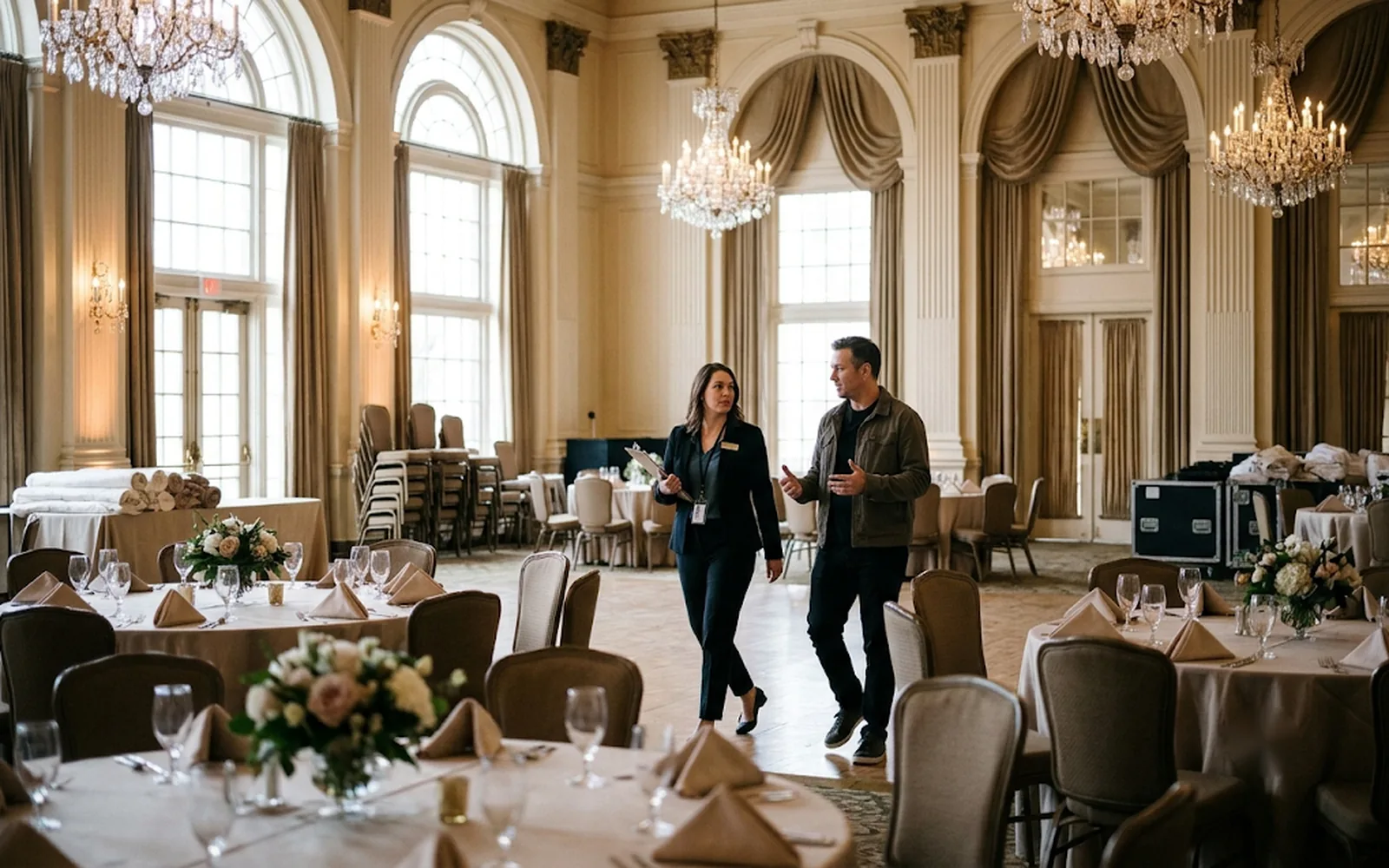
4. Get your paperwork ready before anyone asks
Keep these ready to attach in seconds:
- Your certificate of insurance, the one page document from your insurer showing your cover and its expiry date. Many venues also ask to be added as an additional insured, so ask your insurer how that works.
- Any business licence or permits your area or your type of work needs
- Your typical power needs and load in and load out times
- Details of anything a venue may need to approve, such as haze machines, generators, open flame or heavy rigging
When a venue asks, send all of it the same day.
5. Build a one page vendor profile
Venues keep a file. Your job is to be in it, in a format they can use without editing. One page, not a brochure or a slide deck:
- Company name, your name, a direct phone number and email
- What you do in one sentence
- Insurance details, with cover amount and expiry date
- Three or four photos of your work in rooms like theirs
- Typical crew size and how long your load in and load out take
- Anything a venue needs to know, such as power, rigging, noise or haze
- Your reply time promise, for example "We reply to every venue message within four business hours"
That last line is worth more than it looks. Coordinators deal with vendors who go quiet, so a clear promise stands out. Send it as a PDF named with your company name, what you do and the year, because it will be saved and searched for later.
6. Ask for a small yes first
Cold messages to venues fail mostly because they read like sales pitches. Change the ask.
Keep your first message short. Say who you are and where you work, name a venue or two nearby where you've worked, mention one thing you noticed about their space, attach your profile and offer to be a backup when their usual vendor isn't available.
Don't ask to be added to the list yet. Asking a stranger for the biggest thing first is what gets ignored. Being a backup is a much easier yes, and backups get called more than you'd think, because the usual vendor is often already booked on the busiest dates.
An example
A DJ writing to a wedding venue might say: "I play a lot of weddings in barn venues nearby, including two at [a nearby venue] last summer. I noticed your reception space opens onto the terrace, which is great for a sunset first dance. If your usual DJ is ever booked, I'd be glad to be your backup. My one page profile is attached, with insurance details and photos from similar rooms."
7. Follow up with something useful, timed to the season
Most venues won't reply to the first message. That's normal.
Second message, two to three weeks later. Add something new instead of repeating yourself: a photo from a recent event in a similar room, your open dates in their busy months, or a quick idea for one of their spaces. An AV company might suggest where speakers could go in a long ballroom so speeches reach the back tables.
Third message, before the list is reviewed. Many venues update their vendor lists once a year or before their busy season. Being familiar to the coordinator at that moment is often what gets you added. If you can, ask early when they review it, and time this message for a few weeks before.
Then a check in every few months. A new photo or a short note, just enough to stay remembered.
If you'd rather not write these from scratch, the Venue List Guide has the first message, the follow ups and the profile template ready to use, and it's free.
8. Treat your first event at the venue as an audition
Your first job at a new venue is an audition, because it is.
- Confirm load in details a few days before, then arrive early.
- Introduce yourself to the coordinator in person.
- Ask where they'd like cases and empty boxes stored.
- Keep your crew tidy and out of the guests' way.
- Leave the space cleaner than you found it.
- Send a thank you afterwards, with a few photos they're free to use.
That one event decides whether you become the name they mention first or just a name on a list. A tent company that leaves the lawn spotless and a photographer who sends the venue room shots the next week are making the same point: you're easy to have around.
9. Share your photos and stay on the list
Every event you work produces photos the venue wants for its own marketing.
Post them, tag the venue and credit the photographer. Send the best images straight to the coordinator too. The venue's followers see your work, and many coordinators will reshare it, so the venue ends up showing your work to exactly the people you want to reach.
It keeps you in front of the coordinator and builds your own portfolio at the same time.
Once you're listed, keep earning it. Keep your insurance current, keep sending photos and thank the coordinator when a referral books.
What most event businesses get wrong
- Asking to be listed in the first message. It's the biggest ask, made to a stranger.
- Selling instead of reducing risk. Venues are asking who won't cause problems.
- Sending a brochure instead of a profile. A coordinator wants one page of facts, not ten pages of gear.
- Chasing too many venues. Fifty weak relationships are worth less than ten strong ones.
- Going quiet after one message. Most of the results come from the second and third contact.
- Treating the first event like any other job. It's when the coordinator decides about you.
What probably won't work
"We'll just email every venue in the city." A mass email reads like a mass email. Coordinators delete it.
"We'll offer the lowest price." A discount doesn't make you safer to recommend. It can make you look less established.
"Once we're listed, we're set." Lists are reviewed, and names come off as well as go on.
A better approach:
- Pick a few venues
- Remove the risk
- Earn a small yes
- Prove it
- Stay visible
A 30 day plan
Week 1, preparation. Gather your insurance certificate and paperwork. Write your one page profile and choose three or four strong photos for it.
Week 2, research. Choose ten venues that host the events you want and sit inside your area. Find the right contact at each, check their vendor rules and note who's on their list now.
Week 3, first contact. Send your first message to all ten, each with one detail about that venue and your profile attached. Ask to be a backup.
Week 4, follow up and content. Post photos from recent events, tagging the venues. Schedule your second messages and note when each venue reviews its list.
You won't be on ten lists in 30 days. But ten coordinators will know your name, and that's where every listing starts.
What is one extra booking worth to you?
Move the sliders to match your business. It only takes a few seconds, and nothing you enter leaves this page.
Bookings a month6
Booking money a month$9,000
One extra booking a month is worth$18,000 a year
If just one more enquiry in 10 booked, that would be 2 more bookings a month.
Get your free checkQuestions
What is a preferred vendor list?
It's the short list of suppliers a venue recommends to its clients, such as DJs, caterers, photographers, florists, rental companies and AV crews. Venues share it with couples, planners and corporate clients, often in their booking pack or on their website. Being on it means clients hear your name from someone they already trust.
How do I get on a venue's preferred vendor list?
Make yourself safe to recommend. Have your paperwork ready, send a one page profile, offer to be a backup first and follow up with something useful. Then run your first event there well.
What's the difference between a preferred vendor and an exclusive vendor?
A preferred vendor is recommended, but clients can still bring in someone else. An exclusive vendor is the only one allowed in that category, often an in house team for catering or AV. If your category is exclusive at a venue, spend your time elsewhere.
Do venues charge to be on their preferred vendor list?
Some do, either as a yearly fee or a referral fee per booking, and many don't. Ask what the fee includes and how many referrals the venue usually sends. Then work out how many bookings you'd need to make it worth paying.
How long does it take to get on a preferred vendor list?
It varies. Many venues update their lists once a year or before their busy season, so expect a few months of steady contact and at least one good event there.
What should I send a venue coordinator?
A short message with one detail about their venue, plus a one page PDF profile covering what you do, your contact details, your insurance, a few photos from similar rooms and your load in needs. Leave the long brochure and price list out of the first message.
The LitBooked takeaway
Venues don't choose the vendors who pitch hardest. They choose the ones who feel safe to recommend.
So remove the risk, ask for a small yes, prove it on the day and stay visible.
If you want the ready made version, the Venue List Guide gives you the outreach messages, the profile template and the follow up timing, free. If you'd rather have it done for you, our Premium plan runs the whole process every month, from picking the right venues to presenting your work and following up. It starts at $1,500 a month.
Before a coordinator recommends you, they'll probably look you up. Our free check shows you what they'll find: within 48 hours you get a personal 5 minute video on your Google listing, website and Instagram, with what's working, the three things costing you bookings and the one fix to make first. It's free, and no call is needed.
Get your free check