The short answer
The most useful marketing ideas for event businesses are:
- Turn every event into several pieces of marketing.
- Build content for each area you serve.
- Get your Google Business Profile right.
- Create content for specific venues.
- Build relationships with venues and planners.
- Show before and after transformations.
- Create educational content.
- Turn portfolio projects into case studies.
- Build a system for getting reviews.
- Turn client questions into content.
- Use Pinterest to get discovered.
- Create useful pages for each service and event type.
- Follow up with past enquiries.
- Build a deliberate referral system.
- Measure which marketing actually produces bookings.
But don't try all 15 at once.
Start with the part of your marketing that's weakest right now.
If you run an event business, you probably already have something most businesses would love to have:
Work that looks good on camera.
Whether you're a DJ, an AV company, a tent rental company or a wedding vendor, the challenge is turning that work into a system that keeps helping the right people find you, trust you, enquire and book.
That means going beyond "post more on Instagram." Your best chances can come from your finished events, Google, your website, venues, referrals, helpful content and follow up.
Here are 15 practical marketing ideas for event businesses and, more importantly, how to use them as parts of one connected system.
The LitBooked marketing ideas framework
Instead of treating these as 15 unrelated tactics, sort them into five jobs:
- Get found: help the right people discover your business.
Google, local SEO (showing up when people nearby search on Google), Pinterest, social media, content for each area you serve
- Get trusted: show them why you deserve a closer look.
Portfolio, reviews, case studies, transformations, education
- Get referred: become known by the other people who work events.
Venues, planners, DJs, AV companies, rental companies, photographers
- Get contacted: make the next step easy.
Website, service pages, proof, enquiry forms, clear calls to action
- Get booked: turn interest into a real booking.
Replies, quotes, follow up, sales process
Here's the important part:
A marketing idea is only useful when you know what job it's supposed to do.
1. Turn one event into several pieces of marketing
One finished event shouldn't become one Instagram post and then disappear.
A single wedding, corporate event, gala or private party can become:
- A before and after post
- A portfolio project
- A short video
- An idea post for that specific venue
- An educational post
- A Pinterest pin
- A photo for your Google Business Profile
- A client review
Think: 1 event → many pieces of content → many chances to be found. You already did the hard part: you did the work.
Now get more marketing value out of it. A DJ can pull a dance floor clip and a venue post from one wedding. A rental company can get a setup timelapse and a styled table photo from one weekend.
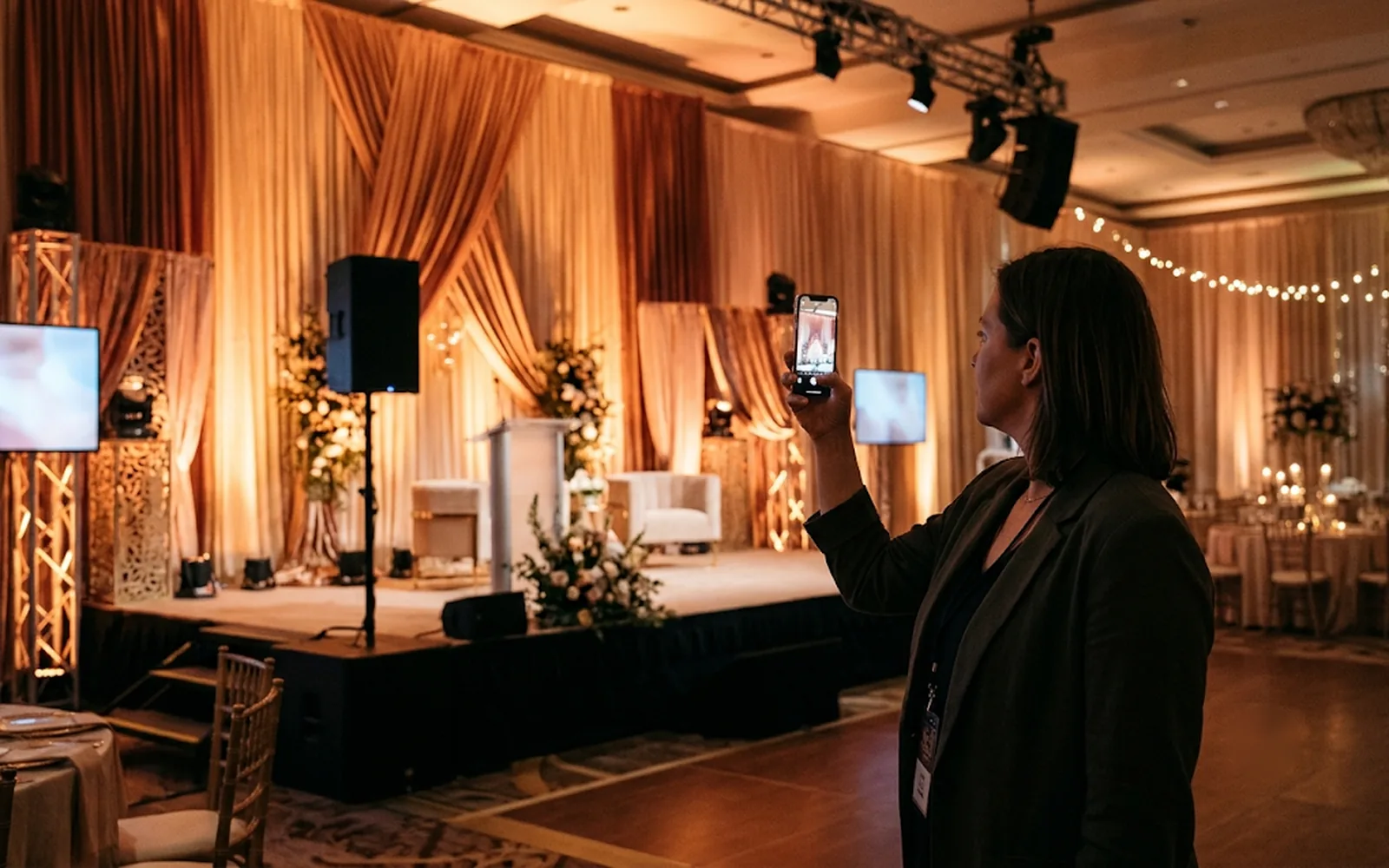
2. Build marketing for each area you serve
People don't always search for a general "event company."
They search for exactly what they need, where they need it:
- DJ in Dallas
- Tent rental in Orlando
- AV company near me
- Corporate event production in Miami
- Wedding photo booth in Atlanta
That means your marketing should say clearly what you do and where you do it.
Create useful local pages and content for the areas you actually serve.
But don't make dozens of pages where only the city name changes.
A useful local page has real detail: the right services, event types, examples, local venues, FAQs and a clear next step.
Local detail matters more than repeating a city name.
3. Get your Google Business Profile right
Your Google Business Profile is the box with your map, photos and reviews on Google. For a local event business, it should make three things obvious:
What you do. Where you work. What your work looks like.
Keep your profile accurate and complete, and add new photos from real events often.
Think beyond gear photos.
Show: empty space → your setup → finished event. A bare hall, then the stage going in, then a full room.
Your profile should help someone understand what you create before they ever visit your website.
4. Create content for specific venues
This is one of the best ways to combine marketing with venue relationships.
Instead of just posting:
"Wedding at XYZ Venue," create something more useful:
"5 ideas for weddings at XYZ Venue." Show how you would approach that particular space.
For example:
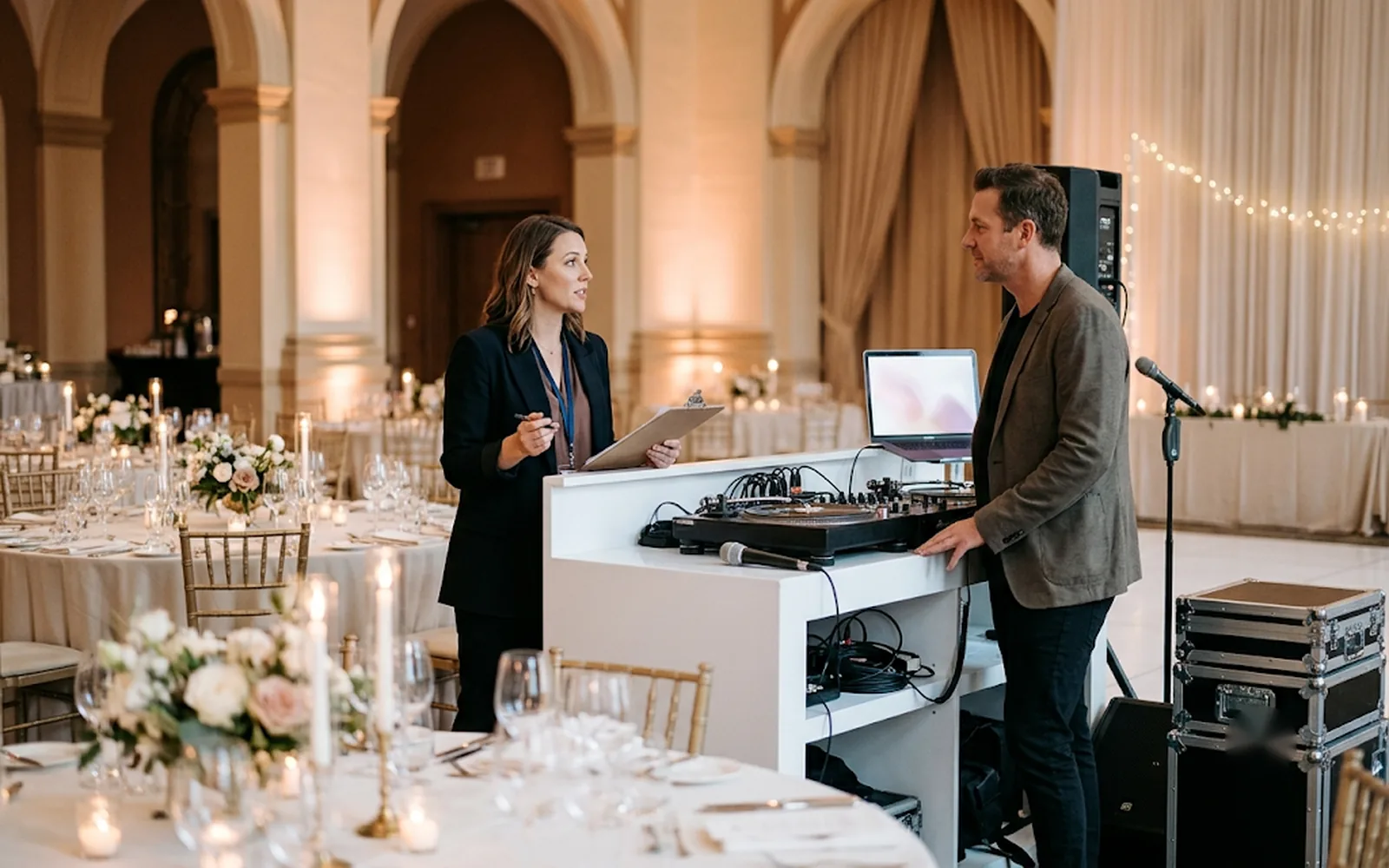
- A DJ in a large ballroom: where the booth and speakers go so the dance floor fills up.
- A tent rental company at an outdoor venue: which tent fits the lawn and where the dance floor sits.
- A decor company in an industrial venue: how draping and greenery soften brick and steel, with a lighting crew adding warm accents.
This kind of content serves two audiences at once: couples and planners looking for ideas, and venues looking for vendors to recommend.
5. Build relationships with venues and planners
The people already planning events can become a strong source of good enquiries.
But a generic message like:
"Hi, we're an AV company. Please keep us in mind." is easy to ignore.
Instead, research the venue or planner first. Then create something useful.
For example:
"We looked at your reception space and came up with three setups that could work really well for evening weddings." Now you're showing that you understand their space.
The process becomes:
Research → create something useful → introduce yourself → show your work → follow up → build the relationship You're not just asking for a referral. You're becoming useful.
6. Show before and after transformations
Almost every event business changes a space, which makes before and after content one of your strongest tools.
Don't only show the finished room. Show what changed.
- Rental and decor: a bare field becomes a tented reception.
- Production and AV: an empty hall becomes a stage with screens, sound and lighting.
- DJs: a quiet room at 7 pm becomes a packed dance floor at 10 pm.
This answers a question clients often have:
"What difference will this actually make?" A finished photo shows the result. A transformation shows the value of hiring you.
7. Create educational content
Not every piece of content needs to sell.
Teach potential clients something they actually want to know.
For example:
How early should we book a DJ for a wedding?
What size tent do we need for 150 guests?
What AV does a corporate conference need?
What's the difference between uplighting and pin spotting?
When should we book our wedding vendors?
How much does a photo booth cost?
What should we ask before hiring an event business?
How much does event production cost?
Helpful content builds trust before someone ever sends an enquiry.
8. Turn portfolio photos into case studies
A photo proves you did an event. A case study shows how you think.
Use a simple structure:
Event → space → challenge → your approach → result For example:
"A large reception room felt flat and empty after sunset. The plan added draping along the walls and moved the DJ booth to anchor a clear dance floor, so the room felt full." Now the prospect isn't just looking at a photo. They're seeing how you solve problems. That difference matters.
9. Build a review system
Don't leave reviews to chance.
Have a set way to ask for feedback after good events.
Real reviews can back up the things clients care about:
- Communication
- Professionalism
- Reliability
- Setup and load out
- Quality of work
- The overall event experience
And keep real reviews real.
Don't make up testimonials or write claims for your clients.
The goal is to make it easy for happy clients to share what actually happened.
10. Turn client questions into content
Your sales conversations are full of marketing ideas.
If couples keep asking a DJ:
"Can you play our list and still read the room?" that's a content topic.
If planners keep asking an AV company:
"Can you run a hybrid event with remote speakers?" that's another.
If a rental company keeps hearing:
"Do we need a backup plan for rain?" that's another.
Keep a simple list of questions clients keep asking. Then turn them into:
Articles → FAQs → videos → social posts → Pinterest content → sales resources This ties your content to real client worries, so you don't have to keep inventing topics.
11. Use Pinterest to get discovered
Events are visual, and couples and planners collect ideas on Pinterest.
Create content around specific ideas such as:
- Wedding reception ideas
- Tent wedding ideas
- Vineyard wedding decor
- Outdoor dance floor ideas
- Photo booth backdrop ideas
- Corporate event stage design
- Luxury wedding reception setups
But don't stop at the image.
Each pin should lead somewhere:
Pinterest → a relevant article → your website → enquiry That turns inspiration into a website visit.
12. Create useful pages for each service and event type
A single general services page can't answer every client's question.
Depending on your business, useful pages might focus on:
- Wedding DJ + city
- Tent rental + city
- Corporate AV + city
- One service for one event type, like photo booths for company parties
Each page should have a real purpose.
Include the right services, examples, FAQs, locations, proof and a clear next step.
Don't create hundreds of nearly identical pages just to show up for more searches.
Create pages because they're useful to people, not because you can swap in a city name.
13. Follow up with past enquiries
A client who didn't book right away isn't necessarily lost for good.
Look at your past enquiries and sort them:
- No response
- Still deciding
- Event postponed
- Date changed
- Lost on price
- Chose someone else
- Outcome unknown
Then follow up with something useful.
Instead of:
"Just checking in." try:
"We just finished a reception a lot like yours and thought the setup might give you ideas." Or answer a question they asked before.
Good follow up gives them a reason to keep talking.
14. Build a deliberate referral system
Think about everyone already connected to the events you want:
Planners, venues, DJs, AV companies, rental and decor companies, photographers, florists and other vendors. Then pick the relationships most likely to send you the right work.
The goal isn't:
"Please send us referrals." It's:
"How can we become a useful partner you remember?" That mindset changes the relationship from asking for leads to helping each other.
15. Measure what actually produces bookings
Don't judge your marketing only by:
Followers, likes, views or website traffic. Track the whole journey:
Seen → visit → enquiry → reply → quote → follow up → booking Then write down where each enquiry came from.
For example:
| Source | Enquiries | Quotes | Bookings |
| Venue referrals | |||
| Planner referrals | |||
| Direct |
The point isn't to build a complicated report.
It's to answer one important question:
Which marketing is actually bringing in business?
What most event businesses get wrong
- Posting more without knowing why. More content doesn't automatically fix a problem with being found or getting enquiries.
- Marketing gear instead of results. Clients aren't buying speaker models or tent sizes. They're buying what your work does for their event.
- Treating Instagram as the whole plan. Social media helps people find you and see proof, but it works better connected to your website, Google and your enquiry process.
- Ignoring venues. Venues and planners already talk to people planning events. That makes them a key part of how event businesses get booked.
- Creating generic content. "5 marketing tips for small businesses" could belong to any company. "5 ways a wedding DJ can turn one venue into steady enquiries" is specific.
- Measuring attention instead of enquiries. A post with thousands of views isn't automatically bringing in business. Track what happens after the attention.
What probably won't work
| Approach | What to expect |
| Posting more without a plan | Probably won't fix the real problem |
| Relying only on Instagram | Might work for some businesses, but leaves you dependent on one app |
| Paying for traffic before fixing your website and follow up | Sends more people into the same weak process |
| Creating useful local and educational content | A stronger approach |
| Connecting search, content, proof, relationships and follow up | The most complete approach |
The goal isn't to use every channel.
The goal is to give every marketing activity a job.
A practical 30 day starting plan
Week 1: get found
Review your Google Business Profile, website, service areas and the searches that matter most.
Week 2: get trusted
Turn your best events into case studies, transformations and review requests.
Week 3: get referred
List the venues and planners that fit your work and start reaching out personally.
Week 4: get measured
Set up a content routine you can repeat and start tracking enquiries, quotes, bookings and where they came from.
Don't try to perfect everything in 30 days.
Make one improvement, measure it, then improve the next part.
What should you work on first?
Can't be found?
Start with local visibility and search.
People find you but don't trust you?
Improve your portfolio, reviews, case studies and proof.
People visit but don't enquire?
Improve your website wording, service pages and enquiry form.
Enquiries aren't turning into bookings?
Look at how fast you reply, your quotes, your follow up and your sales process.
Already getting bookings but leaning heavily on referrals?
Build a deliberate venue and partner pipeline.
You don't need every marketing idea today. Fix the biggest gap first.
The five part LitBooked marketing system
The 15 ideas above get much easier to manage when you organize them around five outcomes:
Get found
Search, local visibility, Pinterest, social media.
Get trusted
Portfolio, reviews, case studies, transformations, education.
Get referred
Venues, planners, DJs, AV companies, rental companies, other event pros.
Get contacted
Website, service pages, proof, enquiry process.
Get booked
Replies, quotes, follow up, sales process.
What is one extra booking worth to you?
Move the sliders to match your business. It only takes a few seconds, and nothing you enter leaves this page.
Bookings a month6
Booking money a month$9,000
One extra booking a month is worth$18,000 a year
If just one more enquiry in 10 booked, that would be 2 more bookings a month.
Get your free checkQuestions
What are the best marketing ideas for an event business?
Local SEO, a well kept Google Business Profile, venue relationships, educational content, your portfolio, social media, Pinterest, real reviews, referrals and steady follow up.
How can an event business get more enquiries?
Start by finding where your current bookings come from. Then strengthen those channels while improving each step between being found, enquiry, quote and booking.
Should an event business focus on Instagram or SEO?
They do different jobs. SEO (search engine optimization) helps people already searching for a service like yours find you on Google. Instagram helps people discover your work and see proof. They work best together.
How can event businesses get more venue referrals?
Research venues that fit your work, learn their spaces, create useful ideas for them and build the relationship before asking for referrals.
What should an event business post on social media?
Transformations, finished events, education, your process, client proof, venue ideas and answers to questions clients actually ask.
How do I know which marketing idea is working?
Track the journey from where someone found you to enquiry, quote and booking. That separates attention from real business.
The LitBooked takeaway
You don't need 100 marketing tactics.
You need a marketing system where every activity has a purpose.
Get found. Get trusted. Get referred. Get contacted. Get booked.
Start with your biggest gap, make one improvement at a time and measure what happens.
Because the goal of marketing an event business isn't just to create more content.
It's to give the right clients more chances to discover your work, trust your business and book you.
Get your free check