An event lighting company can have a good website, strong Instagram content, dozens of Google reviews, and an impressive portfolio—and still have an inconsistent booking calendar.
Why?
Because marketing isn't just about attracting attention.
A potential client has to move through several stages before becoming a customer.
Get your free visibility audit →
They need to:
Discover your company → become interested → trust your work → inquire → consider your proposal → follow up → book.
That journey is your marketing funnel.
For an event lighting company, understanding the funnel helps you answer a much more useful question than:
"What marketing should we do?" Instead, you can ask:
"Where are potential customers getting stuck?" This guide breaks down the event lighting marketing funnel and shows how to build each stage into a system that produces more qualified opportunities and bookings.
The Short Answer
An event lighting marketing funnel is the journey a potential client takes from first discovering your company to eventually booking your services.
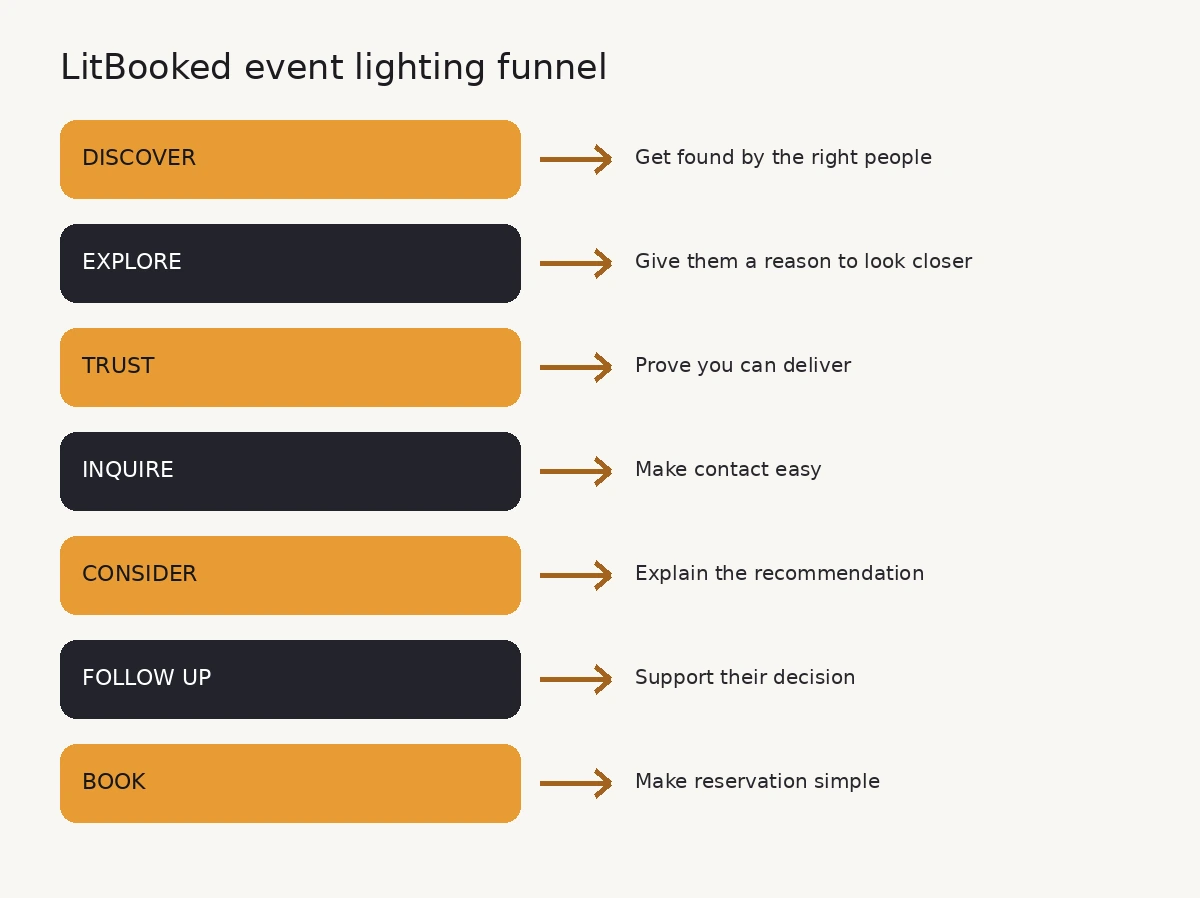
A practical LitBooked funnel is:
DISCOVER → EXPLORE → TRUST → INQUIRE → CONSIDER → FOLLOW UP → BOOK Each stage has a different job.
Discover: Get found by the right people.
Explore: Give them a reason to learn more.
Trust: Prove that you can deliver.
Inquire: Make contacting you easy.
Consider: Help them understand your recommendation and value.
Follow Up: Keep the opportunity moving.
Book: Make the final decision simple.
The important part is that different marketing activities belong to different stages.
Google may create discovery.
Your portfolio may create interest.
Reviews may create trust.
Your website may create inquiries.
Your proposal may influence consideration.
Follow-up may recover opportunities.
And your booking process closes the journey.
The LitBooked Event Lighting Funnel
Here is the complete system:
DISCOVER → EXPLORE → TRUST → INQUIRE → CONSIDER → FOLLOW UP → BOOK Think of it as a series of increasingly committed actions.
A person searching:
"wedding lighting ideas" is not necessarily ready to contact a lighting company.
Someone searching:
"wedding lighting company near me" may be much closer.
Someone who has submitted a detailed inquiry and requested a quote is further down the funnel still.
This is why treating every visitor the same doesn't work.
Why Event Lighting Companies Need a Funnel
Without a funnel, marketing often becomes a collection of disconnected activities.
You post on Instagram.
You update your website.
You ask for reviews.
You contact venues.
You publish a blog.
You receive a few inquiries.
But you don't know how those activities connect.
A funnel gives every activity a job.
| Funnel stage | Prospect question | Marketing job |
|---|---|---|
| Discover | "Who can help me?" | Get found |
| Explore | "Could they be right for me?" | Create interest |
| Trust | "Can I trust them?" | Provide proof |
| Inquire | "How do I contact them?" | Create action |
| Consider | "Is this the right solution?" | Build confidence |
| Follow Up | "Should I move forward?" | Reduce hesitation |
| Book | "How do I reserve them?" | Remove friction |
The goal isn't to push everyone through the funnel as quickly as possible.
It's to give people the right information at the right stage.
Stage 1: DISCOVER — Get in Front of the Right People
The funnel begins before someone knows your company exists.
Potential clients can discover an event lighting company through:
- Google Search
- Google Maps
- Wedding searches
- Venue searches
- Social media
- Referrals
- Planners
- Venues
- Previous clients
- Industry partners
- Event-related content
But discovery only matters if you're reaching the right audience.
A corporate event planner searching for production lighting has a different intent from a bride searching for wedding uplighting.
So your visibility should reflect the types of events and clients you want.
Useful assets at this stage
- Service pages
- Location pages
- Google Business Profile
- SEO content
- Venue-specific pages
- Pinterest content
- Social content
- Referral relationships
The question at this stage is: Are the right people finding you?
Stage 2: EXPLORE — Give Them a Reason to Keep Looking
Getting discovered doesn't mean you've won attention.
A potential client might visit your website and leave within seconds.
They are trying to determine:
"Could this company actually be right for my event?" This is where your visual presentation becomes important.
For an event lighting company, strong exploration assets include:
- Portfolio galleries
- Before-and-after examples
- Venue-specific work
- Service explanations
- Event-type pages
- Lighting inspiration
- Educational articles
- Project examples
Your content should help people imagine what you could do for their event.
A gallery full of beautiful photographs is useful.
A gallery that explains what was done, why it was done, and what the result achieved is much stronger.
Stage 3: TRUST — Give Them Reasons to Believe You Can Deliver
Event lighting is a service where the customer often has to trust you before experiencing the finished product.
They are not buying a physical item that they can inspect beforehand.
They're trusting you with an important event.
That creates a major trust requirement.
Potential clients may want to know:
Have you done events like mine?
Have you worked at this venue?
Do previous clients recommend you?
Are you professional?
Will you arrive prepared?
Can you coordinate with the venue?
Will the finished lighting actually look like the examples?
Your trust assets should answer these concerns.
Strong trust signals include:
- Relevant portfolio — Show work similar to what the prospect wants.
- Reviews — Demonstrate what it is like to work with you.
- Venue experience — Show familiarity with spaces they recognize.
- Process — Explain how planning, setup, coordination, and execution work.
- Specificity — Make it clear what type of lighting and events you specialize in.
The funnel principle is simple:
Don't ask prospects to trust you before you've given them evidence.
Stage 4: INQUIRE — Turn Interest Into an Opportunity
Eventually, the prospect needs to take action.
That might mean:
- Requesting a quote
- Filling out an inquiry form
- Calling
- Booking a consultation
- Sending an email
- Asking a question
This is where many marketing systems leak.
The prospect may be interested but still not know: What should I do next?
Your website should make that obvious.
A good inquiry path should communicate:
What happens when I contact you?
What information should I provide?
When will I hear back?
What will happen after that?
You don't need complicated forms.
You need a clear next step with minimal unnecessary friction.
Stage 5: CONSIDER — Help the Prospect Decide
An inquiry doesn't mean someone is ready to book.
Now they're evaluating you.
They may be comparing:
- Your company
- Another lighting company
- A DJ who also provides lighting
- The venue's preferred vendor
- A production company
- Doing less lighting
- Doing the lighting themselves
This is where your recommendation and proposal matter.
The prospect needs to understand:
What do you recommend?
Why does it fit my event?
What does it include?
What will it accomplish?
Why does it cost what it costs?
A proposal that simply lists equipment forces the client to figure out the value themselves.
A strong proposal connects:
Client need → Lighting solution → Expected result → Investment That's a much easier decision to evaluate.
Stage 6: FOLLOW UP — Don't Let Good Opportunities Disappear
Not every client books immediately.
They may need to:
Discuss it with a partner.
Confirm the venue.
Get approval from a company.
Compare proposals.
Finalize their budget.
Decide what lighting they actually need.
This is where follow-up becomes part of the funnel.
A useful follow-up doesn't simply say:
"Just checking in." Instead, give the prospect a reason to reopen the conversation.
You might provide:
- A relevant project example
- A clarification
- An alternative recommendation
- A venue-specific idea
- An answer to a question
- A reminder about the next planning step
The goal isn't to pressure someone into booking.
It's to remove the reasons they may still be hesitating.
Stage 7: BOOK — Make the Final Step Easy
The final stage should be simple.
Once the prospect has decided:
"Yes, I want to work with you." they shouldn't encounter unnecessary friction.
Make the process clear:
Approve proposal → Sign agreement → Pay retainer → Date reserved → Planning begins Your exact process may differ.
But the client should know:
- How the date is secured
- What they need to sign
- What payment is required
- What happens next
- When planning begins
The easier the final step is to understand, the less opportunity there is for unnecessary hesitation.
What a Healthy Funnel Looks Like
Imagine an event lighting company receives:
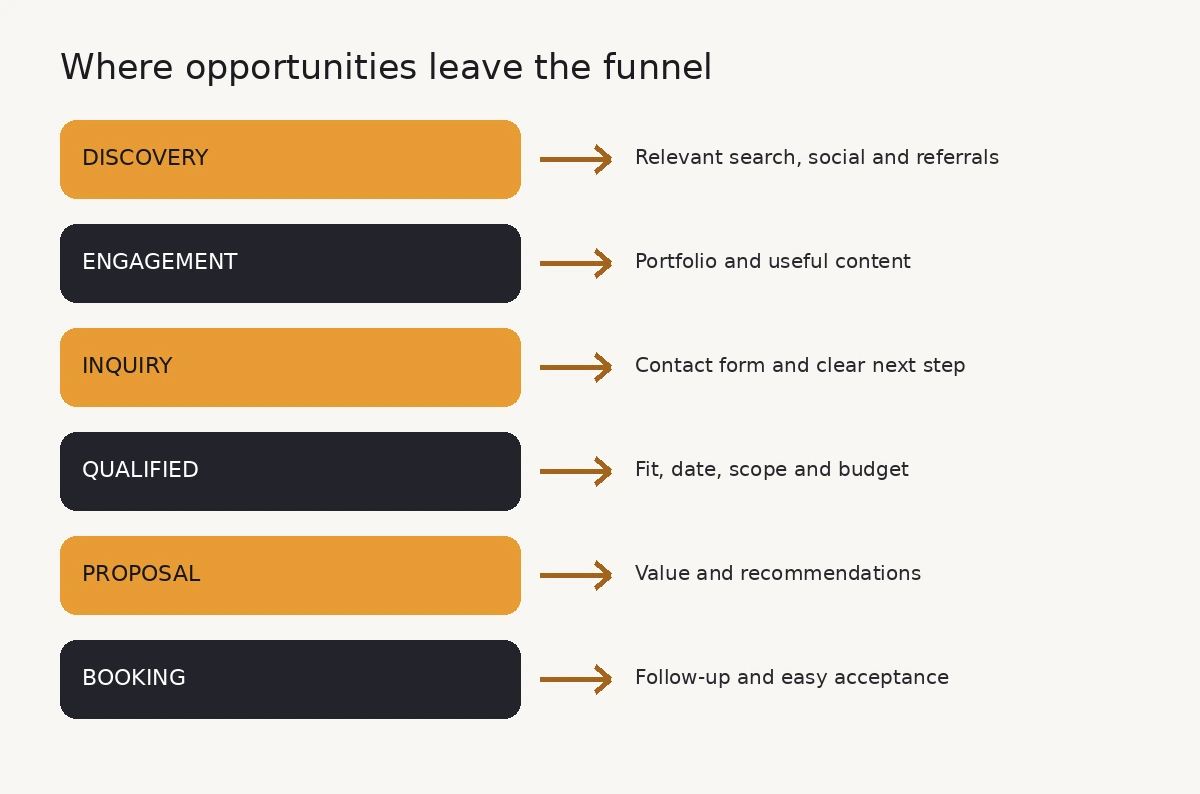
1,000 relevant website visits ↓ 150 engaged visitors ↓ 40 inquiries ↓ 25 qualified opportunities ↓ 18 proposals ↓ 8 bookings These numbers are illustrative—not industry benchmarks.
The point is to understand the movement between stages.
If the company receives 1,000 visitors but only 5 inquiries, the problem may be conversion.
If it receives 40 inquiries but only 3 bookings, the problem may be qualification, proposals, follow-up, pricing communication, or sales.
Without a funnel, these problems look like:
"Marketing isn't working." With a funnel, you can ask:
"Which stage is leaking?"
The Most Important Funnel Metric Isn't Traffic
Traffic is easy to celebrate.
But traffic alone doesn't tell you whether your marketing is working.
Track movement through the funnel:
| Stage | What to measure |
|---|---|
| Discover | Search visibility, Maps visibility, relevant traffic |
| Explore | Engaged visits, key page views |
| Trust | Portfolio/service engagement, reviews |
| Inquire | Inquiry volume |
| Consider | Qualified leads, consultations, proposals |
| Follow Up | Active opportunities |
| Book | Confirmed bookings |
Then look for the largest drop-off.
That is often more useful than simply trying to increase the top of the funnel.
The Three Funnel Problems Most Lighting Companies Have
Problem 1: Not Enough People Enter
You aren't generating enough relevant discovery.
Focus on: SEO, Google Maps, content, social discovery, Pinterest, venues, planners, referrals.
Problem 2: People Enter but Don't Inquire
People see you but don't take action.
Focus on: website clarity, portfolio, proof, service pages, calls to action, inquiry process.
Problem 3: People Inquire but Don't Book
The company generates opportunities but loses too many during consideration.
Focus on: response, discovery, proposals, pricing communication, proof, follow-up, and booking process.
This is why "more traffic" isn't always the answer.
What This Looks Like for Different Lighting Businesses
The funnel stays the same, but the content inside it changes.
Wedding Lighting Company
Discover: "wedding lighting company + city" • Explore: wedding portfolio and lighting ideas • Trust: wedding reviews and venue examples • Inquire: wedding lighting inquiry • Consider: personalized reception lighting proposal • Book:
contract + retainer
AV Company With Lighting
Discover: corporate event production searches • Explore: production portfolio • Trust: corporate case studies and technical experience • Inquire: event requirements • Consider: production proposal • Book: agreement + project planning
DJ Company With Lighting
Discover: DJ + lighting searches • Explore: videos showing the complete experience • Trust: event reviews and examples • Inquire: event date and requirements • Consider: entertainment + lighting package • Book: agreement + deposit The funnel architecture stays consistent.
The buyer's questions change.
Free calculator
Lead value calculator
See what your enquiries are worth today, and what a small lift in conversion adds over a year.
The last figure shows how much more you would book each year if your conversion rate rose by two percentage points.
What Most Event Lighting Companies Get Wrong
They Treat Every Visitor Like a Buyer
Someone reading "wedding lighting ideas" may be researching. Someone searching "event lighting company near me" may be ready to talk.
Better: Match the content and CTA to intent.
They Focus Entirely on the Top of the Funnel
More traffic doesn't solve a broken inquiry process.
Better: Improve the weakest stage first.
They Put Everything Into Social Media
Social can create discovery and trust, but it doesn't automatically create a complete funnel.
Better: Connect social content to your website, proof, inquiry process, and booking journey.
They Stop Marketing Once the Lead Arrives
The funnel doesn't end at the inquiry form.
Better: Treat response, proposal, and follow-up as part of marketing.
They Don't Track the Journey
Without stage-level tracking, every problem looks like a traffic problem.
Better: Track movement from discovery through booking.
What Probably Won't Work
❌ "We Just Need More Traffic" More visitors won't automatically create more bookings if the middle or bottom of the funnel is weak.
⚠️ Posting More Frequently More content may increase discovery, but only if it reaches the right audience and connects to a useful next step.
❌ Sending Every Visitor to "Contact Us" Different prospects need different information before they're ready to inquire.
⚠️ Building a Complicated Funnel A funnel doesn't need ten software platforms and dozens of automated emails. A clear website, useful content, good proof, strong inquiry process, and consistent follow-up can be enough.
🚀 Building the Funnel Around Buyer Questions The strongest funnel answers the questions a prospect naturally has at every stage.
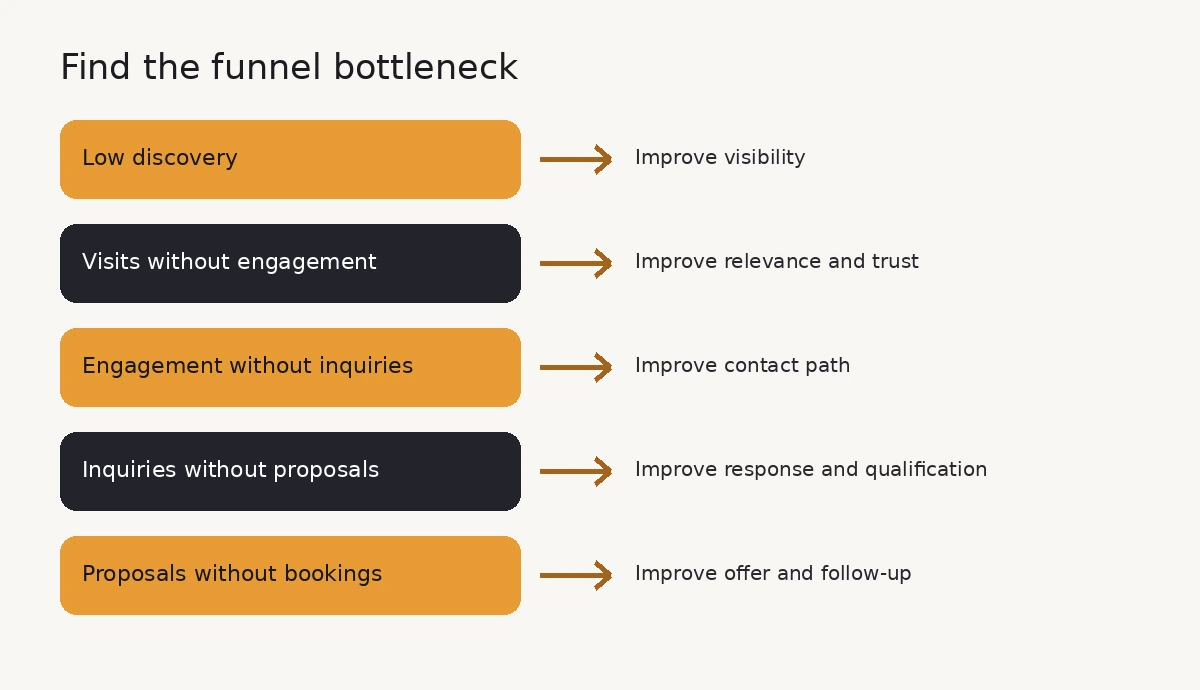
Find Your Funnel Bottleneck
Use this quick diagnostic.
If you're not being discovered:
Visibility problem. Look at SEO, Google Maps, content, partnerships, social discovery, and referrals.
If people visit but leave:
Relevance or trust problem. Look at your messaging, portfolio, service pages, and proof.
If people engage but don't inquire:
Conversion problem. Look at calls to action, inquiry forms, and next-step clarity.
If inquiries don't become proposals:
Qualification or response problem. Look at your first response and discovery process.
If proposals don't become bookings:
Consideration problem. Look at your recommendation, proposal, proof, pricing communication, and follow-up.
If bookings are inconsistent:
Pipeline problem. Look at whether your funnel has enough reliable sources entering the top.
Build Your Funnel in 30 Days
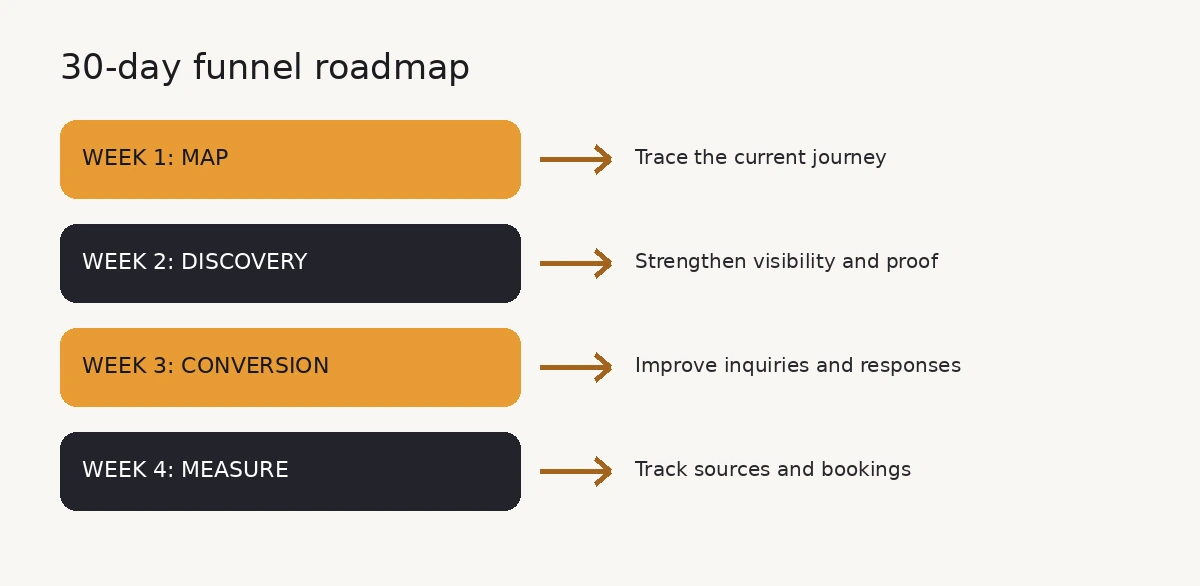
You don't need to rebuild everything at once.
Week 1 — Map the Existing Funnel
Write down:
Where do people discover you?
Where do they go next?
How do they inquire?
How do you respond?
How do you quote?
How do you follow up?
How do they book?
Find the biggest gap.
Week 2 — Strengthen Discovery and Trust
Improve:
- Google Business Profile
- Important service pages
- Portfolio
- Reviews
- One or two high-value content pieces
- Relevant venue/project examples
Week 3 — Strengthen Conversion
Review:
- Inquiry form
- Calls to action
- First response
- Discovery questions
- Proposal
- Booking instructions
Remove unnecessary friction.
Week 4 — Measure the Funnel
Track:
Discovery → Inquiry → Qualified → Proposal → Booking You don't need perfect analytics.
You need enough information to identify where opportunities are being lost.
What Should You Work on First?
Start with the stage that is weakest.
Not enough people finding you? Work on discovery.
People find you but don't engage? Work on relevance and trust.
People engage but don't inquire? Work on conversion.
You receive inquiries but few proposals? Work on response and qualification.
You send proposals but don't book enough? Work on consideration and follow-up.
You book well but the pipeline is inconsistent? Work on creating more reliable sources of qualified discovery.
This prevents the common mistake of throwing more marketing at a problem that exists somewhere else in the funnel.
Frequently Asked Questions
What is an event lighting marketing funnel?
It is the journey a potential event lighting customer takes from first discovering your company to eventually booking your services. The stages can include discovery, exploration, trust, inquiry, consideration, follow up, and booking.
What should be at the top of an event lighting funnel?
Visibility assets such as Google Search, Google Maps, social media, Pinterest, referrals, venue relationships, and educational content can bring potential customers into the funnel.
What should be at the bottom of the funnel?
The bottom of the funnel should make it easy for qualified prospects to evaluate, choose, and book your company. This includes proposals, relevant proof, pricing communication, follow up, contracts, and the booking process.
How do I know where my event lighting funnel is broken?
Track the movement from discovery to inquiry, qualified opportunity, proposal, and booking. The largest meaningful drop off usually tells you where to investigate first.
Do event lighting companies need marketing automation?
Not necessarily. Automation can help with repetitive tasks, but a strong funnel can be built with clear messaging, useful content, good sales processes, consistent follow up, and basic tracking.
The LitBooked Takeaway
A marketing funnel isn't a complicated marketing diagram.
It's simply the path a potential client takes before becoming a customer.
For an event lighting company, that path should look something like:
DISCOVER → EXPLORE → TRUST → INQUIRE → CONSIDER → FOLLOW UP → BOOK Your job isn't to force everyone through that path.
Your job is to make every stage easier.
Help the right people find you.
Give them a reason to explore.
Show them evidence.
Make contacting you simple.
Help them understand the right lighting solution.
Follow up when they're still deciding.
Then make booking straightforward.
When you understand the funnel, "we need more marketing" becomes a much more useful question:
"Which part of our funnel needs to work better?" That's where your next meaningful improvement usually starts.
Get Your Free LitBooked Visibility Audit
Related Resources
How to Market an Event Lighting Company Event Lighting Marketing Ideas Event Lighting Marketing Strategy How to Get More Event Lighting Leads How to Get More Event Lighting Bookings How to Convert More Lighting Inquiries How to Follow Up With Lighting Leads Event Lighting Quote Follow-Up How Fast Should an Event Lighting Company Respond to a Lead?