Getting more event lighting leads is only half the job.
A company can receive inquiries every week and still have an unpredictable booking calendar if prospects disappear after the first conversation, quotes go unanswered, or potential clients don't understand why they should choose one lighting company over another.
The goal isn't simply to generate more inquiries.
It's to turn more of the right inquiries into confirmed bookings.
Get your free visibility audit →
That requires a buying experience that helps a potential client understand the solution, see the value, trust the company, and know exactly what to do next.
This guide breaks down that process specifically for event lighting companies.
The Short Answer
To get more event lighting bookings, improve the journey between inquiry and signed booking.
Focus on:
Sales and follow up services →
- Responding quickly and professionally.
- Understanding the event before recommending a solution.
- Showing relevant proof instead of relying on descriptions.
- Making your proposal easy to understand.
- Selling the outcome, not just the equipment.
- Giving clients clear choices when appropriate.
- Following up systematically.
- Removing uncertainty around quality, price, logistics, and reliability.
- Making the booking step obvious.
- Tracking where good opportunities are being lost.
More bookings don't always require more leads.
Sometimes the fastest way to grow is to convert more of the opportunities you're already generating.
The LitBooked Booking Conversion System
A lead rarely goes directly from:
Inquiry → Booking There are several decisions in between.
LitBooked looks at the journey as:
INQUIRY → UNDERSTAND → RECOMMEND → PROVE → QUOTE → FOLLOW UP → BOOK Each stage has a different job.
INQUIRY — The prospect reaches out.
UNDERSTAND — You learn about the event, venue, priorities, expectations, and requirements.
RECOMMEND — You determine what lighting solution actually fits the event.
PROVE — You reduce uncertainty with relevant projects, reviews, experience, and clear communication.
QUOTE — You make the scope and investment easy to understand.
FOLLOW UP — You keep the opportunity moving instead of allowing the quote to disappear into an inbox.
BOOK — The client knows what happens next and feels confident moving forward.
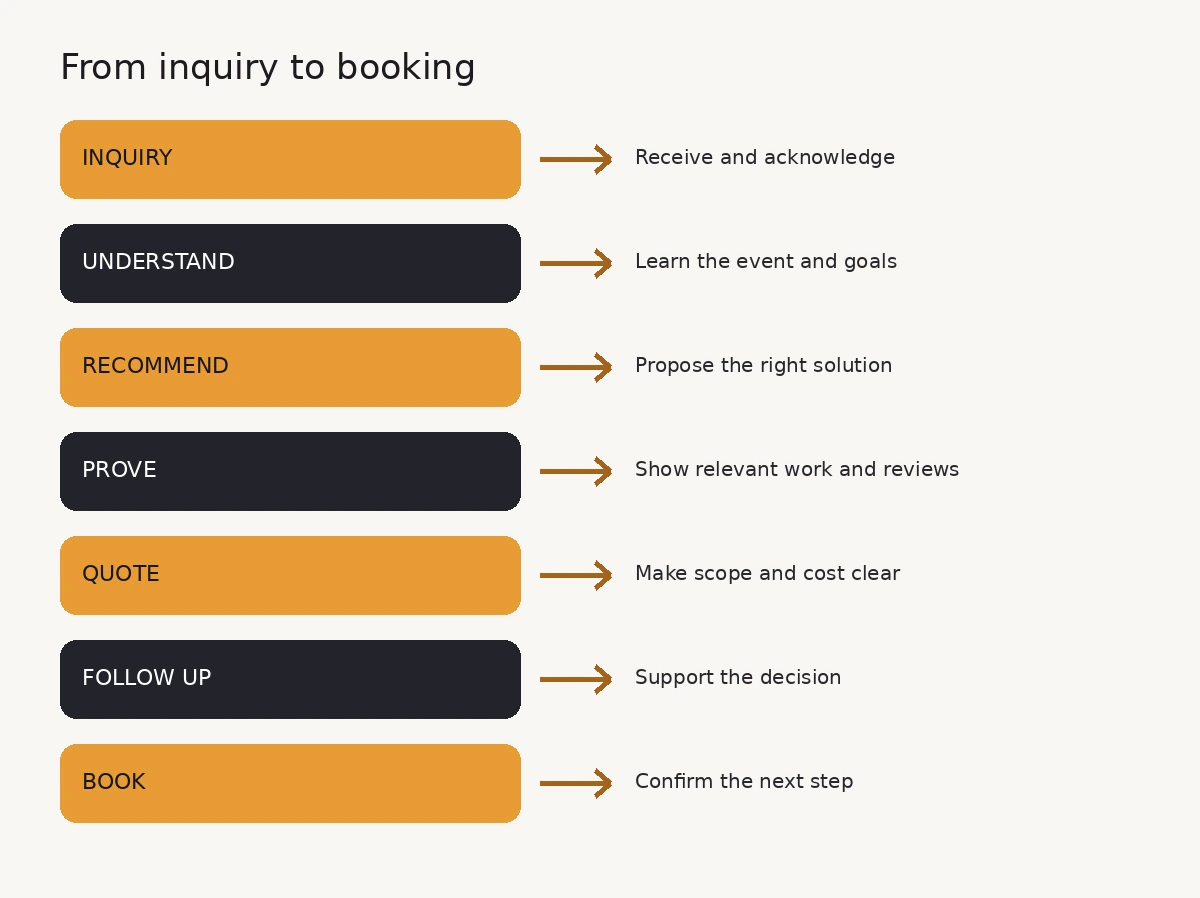
The important idea is that every stage contributes to the sale.
If one stage is weak, the booking can disappear even when the original lead was a good one.
1. Respond Like a Company That Wants the Booking
The first response shapes the client's perception of your company.
If someone submits an inquiry and receives a vague response several days later, uncertainty starts immediately.
A strong first response should make three things clear:
We received your inquiry. We understand what happens next. We're prepared to help you plan the lighting.
You don't need a long sales email.
A simple response can acknowledge the event, explain the next step, and request the information needed to recommend the right solution.
Instead of:
"Thanks for contacting us. We will send pricing soon." try something closer to:
"Thanks for reaching out. We'd love to help with the lighting for your reception. If you send us the venue, event date, guest count, and the atmosphere you're looking for, we can recommend the lighting approach that would work best for the space." The second response starts a conversation.
The first simply acknowledges an email.
2. Stop Quoting Before You Understand the Event
One of the easiest ways to turn a lighting company into a commodity is to quote too early.
A client asks:
"How much is uplighting?" If the immediate answer is:
"$X per light." the conversation quickly becomes about price.
But the client may actually be trying to solve something else.
Maybe they want:
A darker ballroom to feel more dramatic.
Their venue walls to look warmer.
A stronger dance-floor atmosphere.
A romantic wedding reception.
Better lighting for photographs.
Stage lighting for a corporate event.
A complete lighting design rather than individual fixtures.
Before recommending a package, understand the event.
Useful questions include:
What type of event is it?
Where is it taking place?
What do you want the space to feel like?
Which areas matter most?
Is there a stage, dance floor, head table, or focal area?
What lighting have you already considered?
What matters most: atmosphere, photography, branding, functionality, or something else?
The clearer the problem, the easier it becomes to recommend the right solution.
3. Sell the Transformation, Not the Fixture
Clients usually aren't buying "12 LED uplights." They're buying what those lights do to the event.
They're buying:
A more atmospheric ballroom.
A dramatic entrance.
A polished corporate environment.
A better-looking dance floor.
A more cohesive wedding reception.
A branded event environment.
A memorable guest experience.
That's why the strongest lighting sales conversations connect the equipment to the result.
Instead of:
"We provide uplighting, pinspots, and intelligent lighting." show:
"Here's how we would use those elements to transform this room." This matters particularly for lighting companies because the value is visual.
A client may not understand the technical difference between fixtures.
They can understand:
Before → After
4. Show the Right Portfolio Example at the Right Moment
Your portfolio shouldn't simply prove that you've done events.
It should answer:
"Can you create something like what I want?" If a couple is planning a vineyard wedding, show vineyard or outdoor wedding work.
If a client is planning a corporate gala, show corporate work.
If they're considering a particular venue, show work from that venue when you have it.
A relevant project is often more persuasive than a random impressive project.
This creates a simple LitBooked principle:
Match the proof to the prospect's situation.
For example:
Client: "We're getting married in a dark ballroom and want something romantic." Don't immediately send twenty unrelated portfolio images.
Send two or three examples showing how your company created a similar atmosphere.
Now your portfolio is no longer just a gallery.
It's part of the sales conversation.
5. Make Your Quote Easy to Understand
A quote shouldn't force a client to decode your business.
Avoid presenting a long list of equipment without explaining what it accomplishes.
Instead, organize the proposal around the event.
- Reception Atmosphere — Uplighting throughout the ballroom to create a warm, cohesive environment.
- Key Moments — Pinspotting for important tables or décor elements.
- Dance Floor — Dynamic lighting designed to increase energy during the reception.
- Setup & Breakdown — Professional installation, testing, and removal.
The exact services will vary by company.
The principle doesn't:
Show the client what they're getting and why it matters.
The equipment can still be listed.
It just shouldn't be the entire explanation.
6. Give Clients a Clear Choice When Appropriate
Sometimes a prospect isn't saying "no." They're simply unsure what they need.
Clear options can reduce that uncertainty.
For example:
| Option | Best for | What it provides |
|---|---|---|
| Essential | Simple atmosphere | Core room lighting |
| Signature | Most weddings | Layered atmosphere + focal lighting |
| Full Experience | Larger or high-production events | Comprehensive lighting design |
The actual packages should depend on your business.
The principle is what matters:
Don't make the client design the lighting package themselves.
You're the specialist.
Your job is to recommend an appropriate solution.
Too many options create confusion.
The right options create clarity.
7. Make Price Easier to Understand
Price becomes harder to defend when the client doesn't understand what they're receiving.
Instead of simply presenting:
Lighting Package — $2,400 explain what that investment includes.
Depending on your service, that could include:
Lighting design Equipment Delivery Professional setup On-site adjustments Breakdown Venue coordination Technical support Not every company includes all of these.
The point is to make the scope of service visible.
Two companies can appear to offer similar lighting while delivering very different experiences.
Your proposal should make those differences understandable.
8. Remove the Four Booking Uncertainties
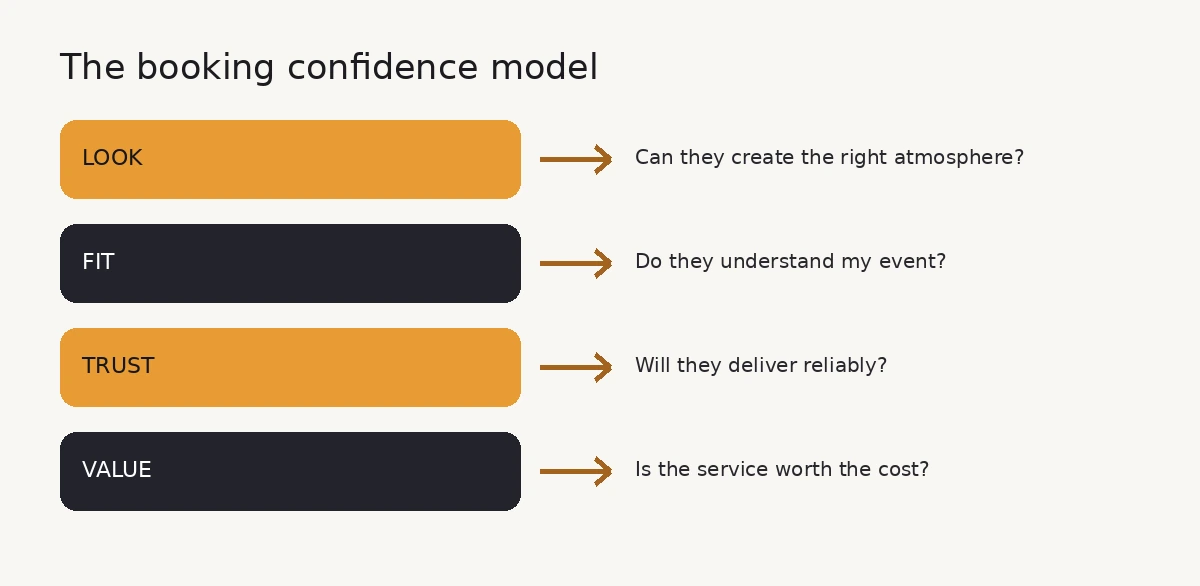
Before committing, most prospects are trying to answer four basic questions:
"Will it look good?" → Show real work.
"Will they understand my event?" → Ask good questions and show relevant examples.
"Will they actually deliver?" → Show reviews, experience, process, and professionalism.
"Is it worth the investment?" → Explain the recommendation and what the service includes.
This creates the LitBooked Booking Confidence Model:
LOOK → FIT → TRUST → VALUE If one of these is missing, a client may hesitate even when they like your work.
9. Use Reviews to Remove Risk
A portfolio shows what you can create.
A review shows what it was like to work with you.
For an event lighting company, reviews can answer concerns such as:
Were they professional?
Did they communicate well?
Did they arrive on time?
Did setup go smoothly?
Did the final result match expectations?
Did they work well with the venue?
Don't treat reviews as something that only belongs on Google.
Relevant testimonials can also appear alongside:
Portfolio projects Service pages Proposal pages Wedding pages Venue-specific pages Put proof close to the decision it helps support.
10. Make Follow-Up a Process, Not a Memory Test
A quote sent once is not a follow-up system.
Clients get busy.
Emails get buried.
Wedding plans change.
Corporate event decisions move between multiple people.
A professional follow-up process keeps the opportunity alive without becoming annoying.
A simple sequence might look like:
- Follow-Up 1 — Confirm they received the proposal and invite questions.
- Follow-Up 2 — Add something useful—a relevant project, idea, or clarification.
- Follow-Up 3 — Ask whether their plans have changed and whether the lighting recommendation still fits.
- Final Follow-Up — Give them an easy way to close the loop.
The timing should reflect your typical buying cycle.
The principle is simple: follow up with context, not pressure.
Free calculator
Lead value calculator
See what your enquiries are worth today, and what a small lift in conversion adds over a year.
The last figure shows how much more you would book each year if your conversion rate rose by two percentage points.
11. Don't Discount Too Quickly
When a prospect says:
"That's more than another company quoted us." the instinct may be to lower the price.
First find out what they're actually comparing.
Are the scopes identical?
Does the other company include setup?
Are they providing the same equipment?
Is someone operating the lighting?
Are delivery and breakdown included?
Are insurance and venue requirements covered?
Is the proposal genuinely comparable?
Price should be discussed in the context of scope and value, not just the final number.
If the client genuinely needs a smaller solution, redesigning the scope may make more sense than immediately discounting the original proposal.
12. Make the Booking Step Extremely Clear
Friction often appears after a client has already decided they want to move forward.
They may wonder:
How do we reserve the date?
Do we need a deposit?
What do you need from us?
Is there a contract?
What happens after we book?
When will we finalize the design?
Your booking process should answer these questions clearly.
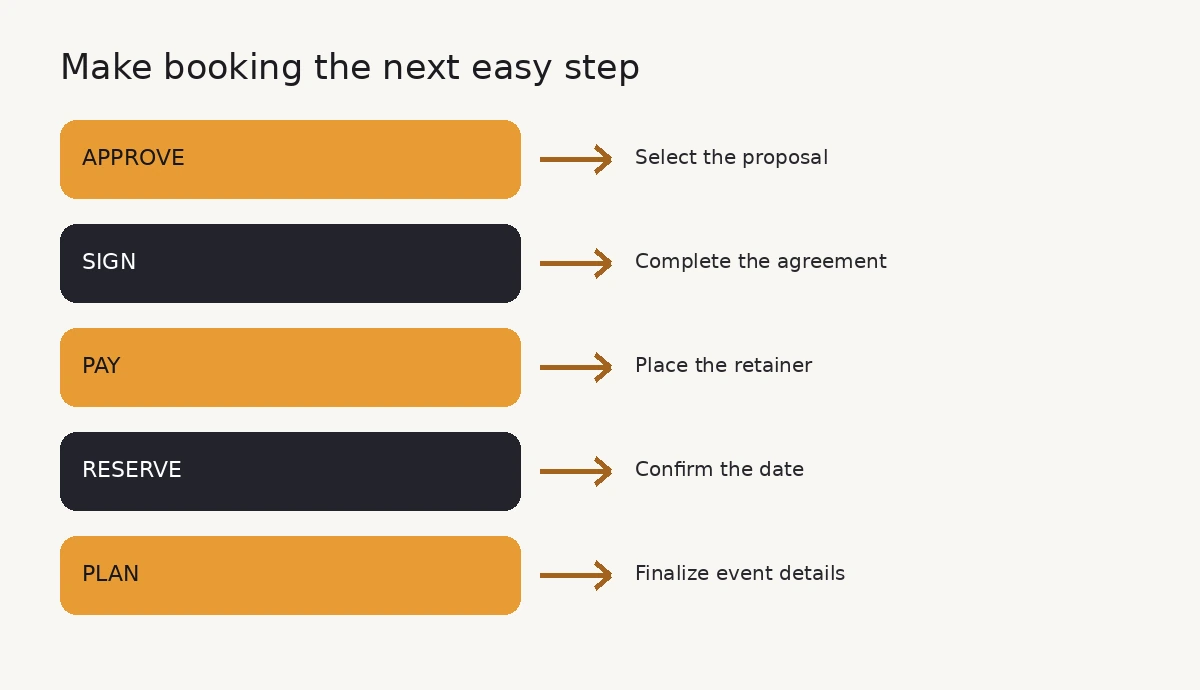
For example:
Approve proposal → Sign agreement → Pay retainer → Date reserved → Planning begins The exact process will differ by company.
But the principle is universal:
Don't make the client ask what happens next.
What This Looks Like for an Actual Lighting Company
Imagine an event lighting company receives ten inquiries in a month.
Six receive quotes.
Four never respond.
Two book.
The obvious conclusion might be:
"We need more leads." But suppose those four lost opportunities all received generic quotes with little explanation, no relevant project examples, and no structured follow-up.
The problem may not be lead volume.
It may be what happens after the inquiry arrives.
A stronger process would look like:
Inquiry → Event discovery → Personalized recommendation → Relevant project examples → Clear proposal → Structured follow-up → Booking The same number of inquiries can produce a healthier booking pipeline when fewer good opportunities are lost along the way.
What Most Event Lighting Companies Get Wrong
They Quote Too Quickly
The client asks for a price, and the company immediately sends a number.
Better: Understand the event before recommending the solution.
They Send Generic Portfolio Galleries
Twenty unrelated photos don't necessarily answer the prospect's question.
Better: Show relevant proof.
They Sell Equipment Instead of Outcomes
"Eight uplights and four moving heads" is technical information.
Better: Explain what those elements accomplish for the event.
They Treat Follow-Up as Optional
One quote email isn't a sales process.
Better: Create a defined follow-up sequence.
They Compete Only on Price
This turns a professional service into a commodity.
Better: Make scope, experience, process, and value visible.
What Probably Won't Work
❌ Sending More Quotes Without Improving Them More proposals won't solve a proposal-quality problem.
⚠️ Offering Huge Discounts Discounts may sometimes help with a genuinely price-sensitive opportunity, but repeatedly using them can weaken positioning and margins.
❌ Following Up With "Just Checking In" Repeatedly asking whether someone has decided gives the prospect little reason to respond.
⚠️ Adding More Packages Options can help when they clarify a decision. Too many options can create more confusion.
🚀 Building the Booking Process Around Client Questions An advanced lighting company anticipates what clients need to know before they have to ask.
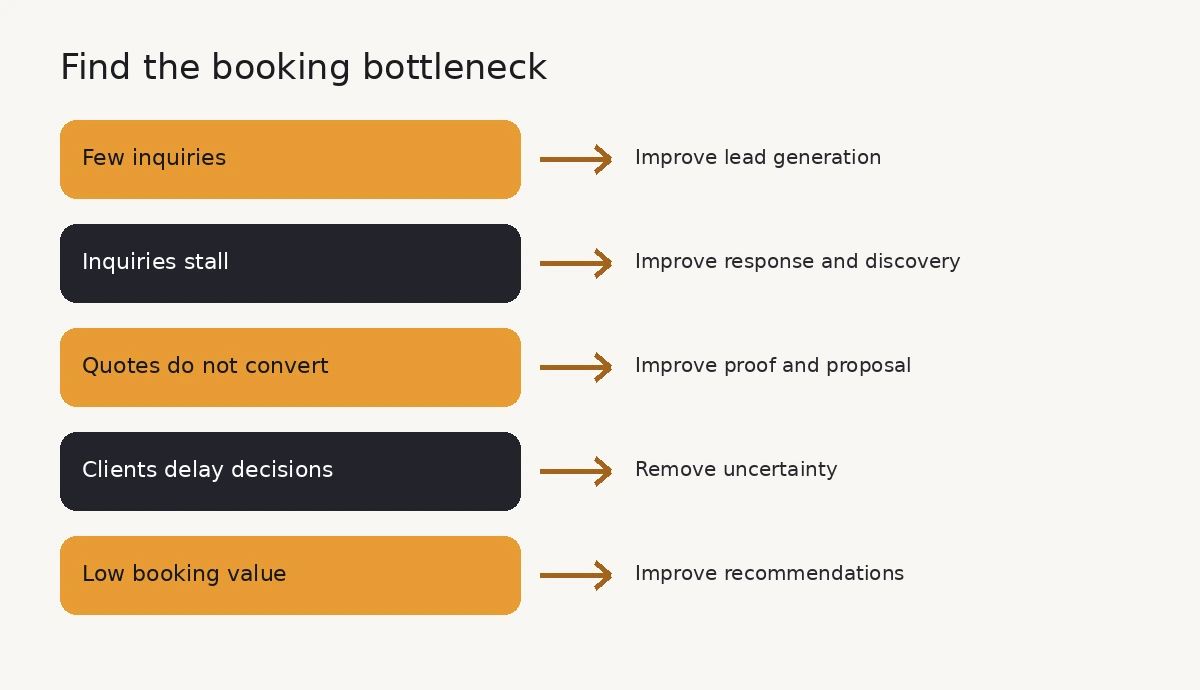
Find Your Booking Bottleneck
Use this simple diagnostic:
Lots of inquiries, few conversations?
Look at response speed and first-response quality.
Lots of conversations, few quotes?
Look at qualification and discovery.
Lots of quotes, few bookings?
Look at proposal quality, proof, pricing communication, and follow-up.
Clients like the proposal but keep delaying?
Look at uncertainty, decision friction, and the booking process.
Clients book but average booking value is low?
Look at recommendation quality, packaging, and relevant opportunities to expand the lighting solution.
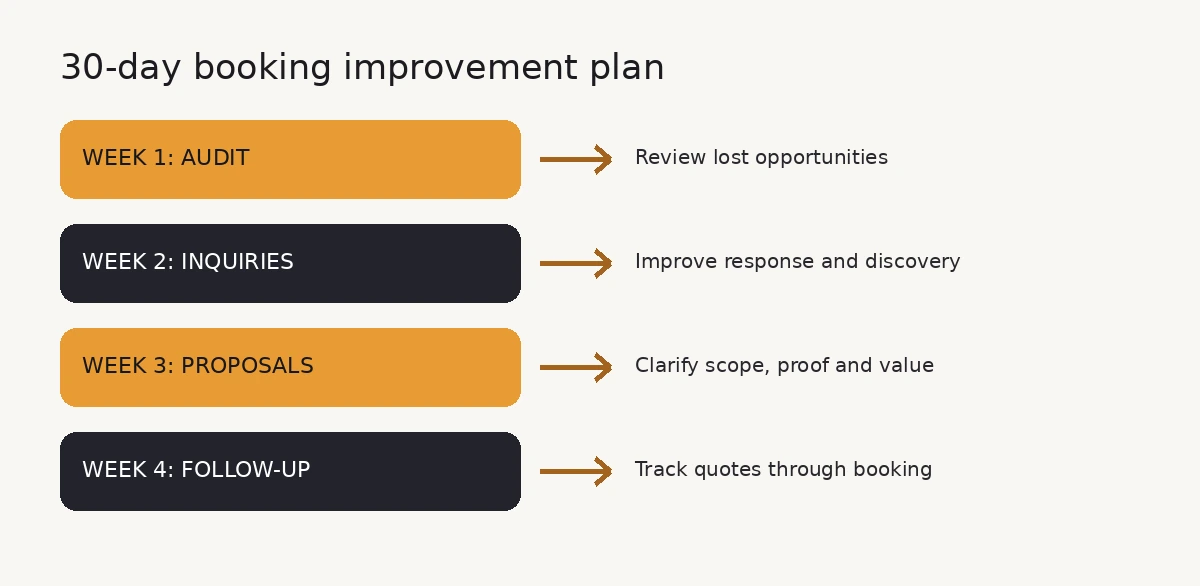
Your 30-Day Booking Improvement Plan
You don't need to rebuild your sales process overnight.
Week 1 — Audit Lost Opportunities
Review your last 20–30 inquiries.
Record:
- Inquiry source
- Event type
- Response time
- Whether a quote was sent
- Quote value
- Follow-up activity
- Outcome
- Reason for loss, if known
Look for patterns rather than isolated examples.
Week 2 — Improve the Inquiry Process
Create:
- A stronger first response
- Better discovery questions
- A consistent qualification process
- A clear handoff from inquiry to consultation or quote
Week 3 — Improve the Proposal
Review your current quote.
Make sure it communicates:
- The client's situation
- Your recommended solution
- Relevant proof
- What's included
- Investment
- Next step
Week 4 — Build Follow-Up Into the System
Create a simple follow-up sequence and track every active opportunity.
Then measure:
Inquiries → Qualified → Quotes → Bookings Now you can see where bookings are actually being won and lost.
What Should You Work on First?
If your company is already receiving event lighting inquiries, don't immediately spend more money trying to generate additional traffic.
Start with the existing pipeline.
If you don't get enough inquiries:
Work on lead generation and visibility.
If you get inquiries but struggle to start conversations:
Improve response and qualification.
If you have conversations but struggle to close:
Improve discovery, proof, recommendations, and proposals.
If quotes go unanswered:
Improve follow-up and reduce uncertainty.
If clients constantly negotiate price:
Improve how your value and scope are communicated.
The right improvement depends on where the booking process is breaking.
Frequently Asked Questions
How can I get more event lighting bookings without getting more leads?
Improve the percentage of existing inquiries that become qualified opportunities, quotes, and bookings. Better response, stronger proposals, relevant proof, and consistent follow-up can improve the path from inquiry to booking.
Why do event lighting leads not book?
There can be many reasons: price, timing, poor fit, weak communication, insufficient proof, unclear proposals, lack of follow-up, or uncertainty about the value of the service. The first step is identifying the pattern rather than assuming every lost lead is a pricing problem.
How quickly should an event lighting company respond to an inquiry?
As quickly as reasonably possible during operating hours. More importantly, the response should be clear and useful rather than simply fast.
Should event lighting companies show prices on their website?
It depends on the business model and service. Some companies benefit from transparent starting prices or package ranges, while highly customized services may require a consultation first. The important thing is to reduce unnecessary uncertainty without creating misleading expectations.
How many times should I follow up with an event lighting lead?
There isn't one universal number. Follow-up should reflect the event timeline and buying process. A small number of useful, well-timed follow-ups is generally more valuable than repeated generic messages.
The LitBooked Takeaway
Getting more event lighting bookings isn't simply about convincing more people to buy.
It's about making the decision easier.
A strong booking system helps the prospect answer:
- Can you create what I want? → Show relevant work.
- Do you understand my event? → Ask better questions.
- Can I trust you to deliver? → Show reviews, experience, and process.
- Is your recommendation right for me? → Explain the solution.
- Is the investment clear? → Make the proposal easy to understand.
- What happens if I want to move forward? → Make booking simple.
The strongest event lighting companies don't leave these questions for the client to figure out themselves.
They build the answers into the buying experience.
So before trying to generate another hundred inquiries, look at the opportunities already entering your business.
Where are potential bookings disappearing?
Fix that point first.
Get Your Free LitBooked Visibility Audit
Related Resources
How to Get More Event Lighting Leads How to Market an Event Lighting Company Event Lighting Marketing Ideas Event Lighting Marketing Strategy Event Lighting Marketing Funnel How to Convert More Lighting Inquiries How to Follow Up With Lighting Leads Event Lighting Quote Follow-Up Event Lighting Proposal Template How Fast Should an Event Lighting Company Respond to a Lead?