Getting more event lighting leads is not usually about finding one more marketing channel.
For most lighting companies, the bigger problem is that leads are being generated inconsistently, or the company is visible in places where potential customers are not ready to inquire.
A strong lead generation system connects where people discover you, what makes them trust you, how easily they can contact you, and what happens after they do.
That means your website, Google presence, portfolio, venue relationships, content, referrals, social media, and follow up should work as one system.
Get your free visibility audit →
This guide shows you how to build that system specifically for an event lighting company.
The Short Answer
To get more event lighting leads, build several reliable paths into the business instead of depending on one source. Focus on:
- Getting found when people search for event lighting.
- Showing proof through real projects, photos, reviews, and examples.
- Building referral channels with venues, planners, DJs, AV companies, and other event professionals.
- Creating useful content around the lighting questions potential clients actually ask.
- Making your website easy to inquire through.
- Responding and following up quickly once someone becomes a lead.
- Tracking where leads come from so you can invest more heavily in what actually produces bookings.
The goal isn't simply more inquiries. It's more qualified inquiries from people who are a realistic fit for your services.
The LitBooked Lead Generation System
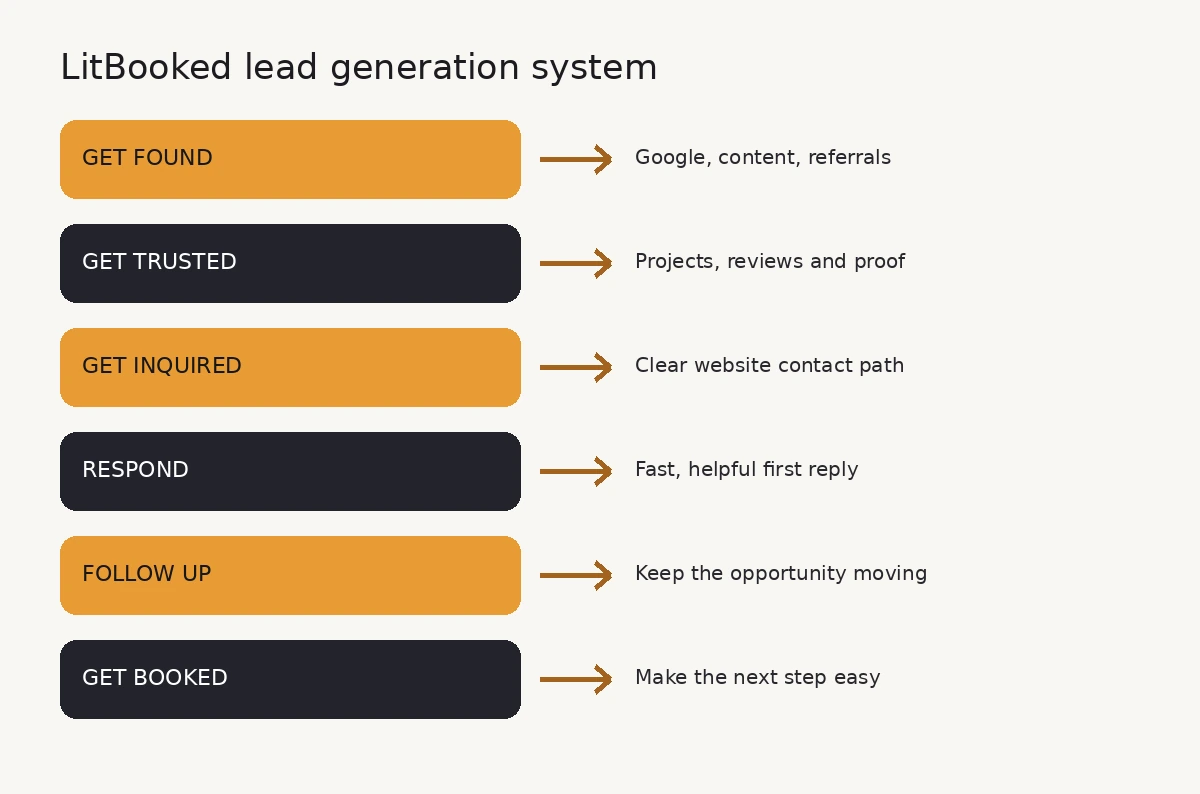
Think about your lead generation as a simple chain:
GET FOUND → GET TRUSTED → GET INQUIRED → GET RESPONDED TO → GET FOLLOWED UP → GET BOOKED
A weakness anywhere in this chain can reduce the number of bookings you generate.
For example:
- Great Google visibility + weak website = people find you but don't inquire.
- Great portfolio + poor visibility = people trust you, but don't discover you.
- Lots of inquiries + slow response = leads disappear.
- Strong marketing + no follow up = opportunities are left unfinished.
So before adding another marketing channel, find the weakest link. That's where your next lead is most likely being lost.
1. Define the Lead You Actually Want
"More leads" is too broad. An event lighting company should know what a good lead looks like.
For example, your ideal lead might be:
- A wedding client planning a 150+ guest reception
- A corporate event needing stage and room lighting
- A venue looking for a recurring lighting partner
- An event planner who regularly recommends vendors
- A production company that needs lighting support for multiple events
These are different lead types, and they may come from different channels. A wedding client might discover you through Google or Pinterest. A planner might come through a referral. A venue may come from direct outreach or a partnership.
So start by identifying the types of customers you want more of, rather than simply trying to increase total inquiries.
2. Find Where Your Existing Leads Come From
Before spending more money or creating more content, look at your existing leads.
Take your last 20 to 30 inquiries and record:
| Lead source | What to record |
|---|---|
| Search / Maps / organic | |
| Referral | Who referred them |
| Venue | Venue or preferred vendor relationship |
| Planner | Planner or coordinator |
| Social media | Instagram, Facebook, Pinterest, etc. |
| Website | Direct / unknown |
| Previous client | Repeat or referral |
| Paid advertising | Campaign/source |
Then look for patterns. You may discover that a large percentage of your best leads already come from two sources.
That changes the question from:
"What other marketing should we try?"
to:
"How can we make our strongest lead sources more predictable?"
That is a much more useful question.
3. Make Your Company Easier to Find on Google
People searching for event lighting are often already expressing some level of buying intent. They might search:
- event lighting company near me
- wedding lighting company
- uplighting company
- event lighting [city]
- wedding lighting [city]
- corporate event lighting
- venue lighting services
Your goal isn't to rank for every possible search. It's to become visible for searches that represent the services and locations you actually want to sell.
That means your website should clearly communicate:
What you provide + where you provide it + who you serve.
Instead of relying on one generic "Services" page, build useful pages around meaningful services, event types, and locations where appropriate. Then connect those pages through internal links and relevant content.
This creates a clearer path from search to service to inquiry.
4. Turn Your Google Business Profile Into a Lead Asset
Your Google Business Profile isn't simply an online listing. For a local event lighting company, it can be one of the first places a potential customer evaluates you.
Your profile should continuously reinforce:
- What you do
- Where you work
- What your installations look like
- What customers say about you
- How someone can contact you
Your photos matter particularly because lighting is visual. Don't only upload polished finished images. Show the experience and transformation: Before → Installation → Finished Event.
Add relevant project photos regularly, keep business information accurate, and build a consistent review process.
The objective is simple: when someone discovers your company through local search, they should have enough evidence to take the next step.
5. Turn Your Best Projects Into Lead Magnets
Your completed events are not just portfolio material. They are marketing assets.
One strong event can become:
- A portfolio project
- A website case study
- An Instagram post
- A Pinterest pin
- A Google Business Profile photo set
- A short video
- A "lighting ideas for [venue/event type]" article
- A sales example
- A client conversation starter
For example, instead of simply posting "Beautiful wedding lighting at XYZ Venue," you could explain what the venue looked like, what lighting challenge existed, what was installed, and how the lighting changed the space.
That gives potential clients something much more valuable than another pretty photograph. They can start imagining their own event.
6. Create Content Around Buying Questions
Not every potential client searches for "event lighting company." Some search for the problem they are trying to solve. Questions might include:
- How much does wedding uplighting cost?
- What lighting is best for a wedding reception?
- How do I make a ballroom look better?
- What lighting works for an outdoor event?
- Do I need uplighting and string lights?
- How much lighting do I need for my venue?
- What lighting should I use for a corporate event?
These questions create opportunities to reach people earlier in the buying process.
The key is to answer them from the perspective of an actual lighting business. Don't create generic event planning content. Explain how lighting decisions affect the event, what options exist, what mistakes to avoid, and what a client should consider before booking. That builds both search visibility and trust.
7. Build a Venue and Planner Lead Pipeline
One venue relationship can potentially create multiple future opportunities. The same is true for planners, DJs, photographers, AV companies, and other event professionals.
Instead of approaching these relationships with "Please refer clients to us," build a reason for the relationship to exist. For example:
- Create a venue specific lighting guide.
- Offer a lighting walkthrough.
- Build a preferred vendor information sheet.
- Show examples from events at their venue.
- Create useful content featuring their space.
- Stay in contact after the first event.
The objective is to become a useful lighting resource, not simply another vendor asking for referrals.
8. Create Venue-Specific Marketing
This is one of the most practical ways to connect content with lead generation.
If you regularly work in particular venues, create content around them. For example: "Wedding Lighting Ideas for [Venue Name]."
Show:
- Where uplighting works
- How the ballroom changes after dark
- Recommended lighting zones
- Examples from previous events
- What couples should consider when planning lighting there
Now your marketing is connected to a real place where events happen. Someone searching for that venue may discover your company while already planning an event. That's much more valuable than publishing another generic lighting post.
9. Use Social Media for Discovery and Proof
Social media should not become a competition to post every day. For an event lighting company, its strongest job is often to help people see what you can do.
Prioritize content such as:
- Transformation, before and after lighting
- Proof, real completed events
- Education, explain why a particular lighting setup works
- Behind the scenes, installation, programming, testing, and preparation
- Venue specific, lighting examples from recognizable venues
- Client experience, reviews, reactions, and event moments
A potential customer should be able to look through your content and quickly understand: "These people can create the kind of event atmosphere I'm looking for."
10. Use Pinterest for Long-Term Discovery
Pinterest can be particularly useful for wedding and event lighting because people often use visual search while planning.
Instead of treating Pinterest like another social feed, think of each pin as an entry point into your website. Examples:
- Wedding uplighting ideas
- Ballroom lighting ideas
- Outdoor wedding lighting
- Vineyard wedding lighting
- Reception lighting ideas
- Modern wedding lighting
- Romantic wedding lighting
Each visual should lead to a useful page or article that continues the conversation.
The goal isn't simply to collect impressions. It's to move someone from inspiration to information to website to inquiry.
11. Build a Referral System Instead of Hoping for Referrals
Happy clients may recommend you, but hoping for referrals is not a system. Build a simple process. After a successful event:
- Ask for a review.
- Ask whether they know someone planning an event.
- Make referring easy.
- Stay in touch with past clients.
- Keep producing work worth sharing.
You can also create referral relationships with complementary vendors. The important distinction is: a referral source should know exactly who you help and what makes your lighting service worth recommending.
Free calculator
Lead value calculator
See what your enquiries are worth today, and what a small lift in conversion adds over a year.
The last figure shows how much more you would book each year if your conversion rate rose by two percentage points.
12. Make Your Website Convert the Traffic You Already Have
Getting people to your website is only half the job. When someone arrives, they should quickly understand:
- What you offer
- Where you work
- What your work looks like
- Who you work with
- Why they should trust you
- How to request information or a quote
Your inquiry path should not require unnecessary effort. A strong portfolio with no obvious next step creates friction. So does a beautiful homepage that doesn't clearly explain the service.
Think of the website as the bridge between "This looks good" and "I want to talk to them."
13. Respond Before the Lead Goes Cold
Lead generation doesn't end when someone submits a form. Your response is part of your lead generation system.
A potential client may contact several lighting companies at the same time. If your company responds quickly, clearly, and professionally, you immediately create a better experience.
The first response should help the prospect understand:
- You received their inquiry.
- What happens next.
- What information you need.
- When they can expect a response.
Speed matters, but clarity matters too.
14. Follow Up With Something Useful
Many event lighting leads don't book after the first conversation. That doesn't necessarily mean they're lost. They may still be:
- Comparing vendors
- Waiting for a venue decision
- Waiting for a planner
- Finalizing their budget
- Deciding what lighting they actually need
Instead of repeatedly asking "Are you ready to book?", follow up with something useful. For example:
- A relevant portfolio example
- A venue specific lighting idea
- An answer to a question they asked
- A simple planning checklist
- Another option that fits their event
Good follow up keeps the conversation moving without making every interaction feel like a sales push.
15. Track Leads From Source to Booking
You cannot improve what you don't measure. At minimum, track:
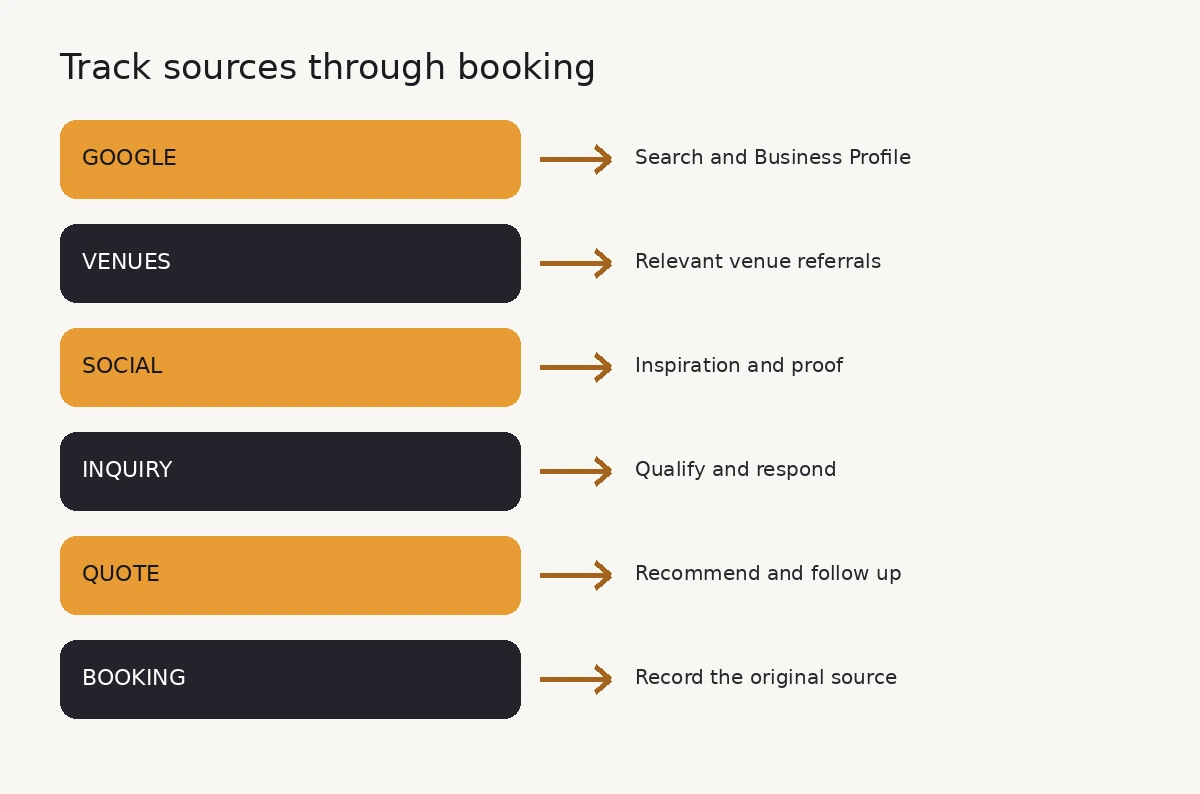
Lead source → Inquiry → Qualified → Quote → Follow-up → Booking
You can then see which sources produce actual business. For example:
| Source | Leads | Quotes | Bookings |
|---|---|---|---|
| 18 | 10 | 5 | |
| Venue referrals | 8 | 7 | 5 |
| 15 | 5 | 2 | |
| Planner referrals | 6 | 5 | 4 |
The exact numbers will vary by business. The important point is that lead volume alone isn't enough. A channel producing fewer leads may generate more bookings.
That is why the real metric is not simply "How many leads did we get?" It is "Which sources consistently create qualified opportunities and bookings?"
What Most Event Lighting Companies Get Wrong
The common mistake is treating lead generation as a collection of disconnected activities.
They post on Instagram. They update their website. They run an ad. They ask for reviews. They contact a few venues. But none of these activities are connected.
A stronger system gives every activity a job:
- Google gets you found.
- Portfolio and reviews build trust.
- Content answers questions.
- Venues and planners create referral opportunities.
- Your website converts interest into inquiries.
- Response and follow up turn inquiries into conversations.
- Sales turns conversations into bookings.
That is a lead generation system.
What Probably Won't Work
Posting More Without a Strategy
More Instagram posts won't automatically produce more leads if the content doesn't demonstrate your work or reach potential buyers.
Relying Entirely on Referrals
Referrals are valuable, but depending on them exclusively makes your pipeline difficult to control.
Buying Leads Without Understanding Quality
A large number of inquiries is not necessarily useful if most are outside your service area, budget, or ideal customer profile.
Sending Everyone to the Same Generic Page
A wedding client, corporate event planner, and venue manager may have completely different questions. Your marketing should reflect those differences.
Chasing Every Marketing Channel
You don't need to be everywhere. You need enough strong channels working together to create a predictable flow of qualified opportunities.
Find Your Lead Generation Bottleneck
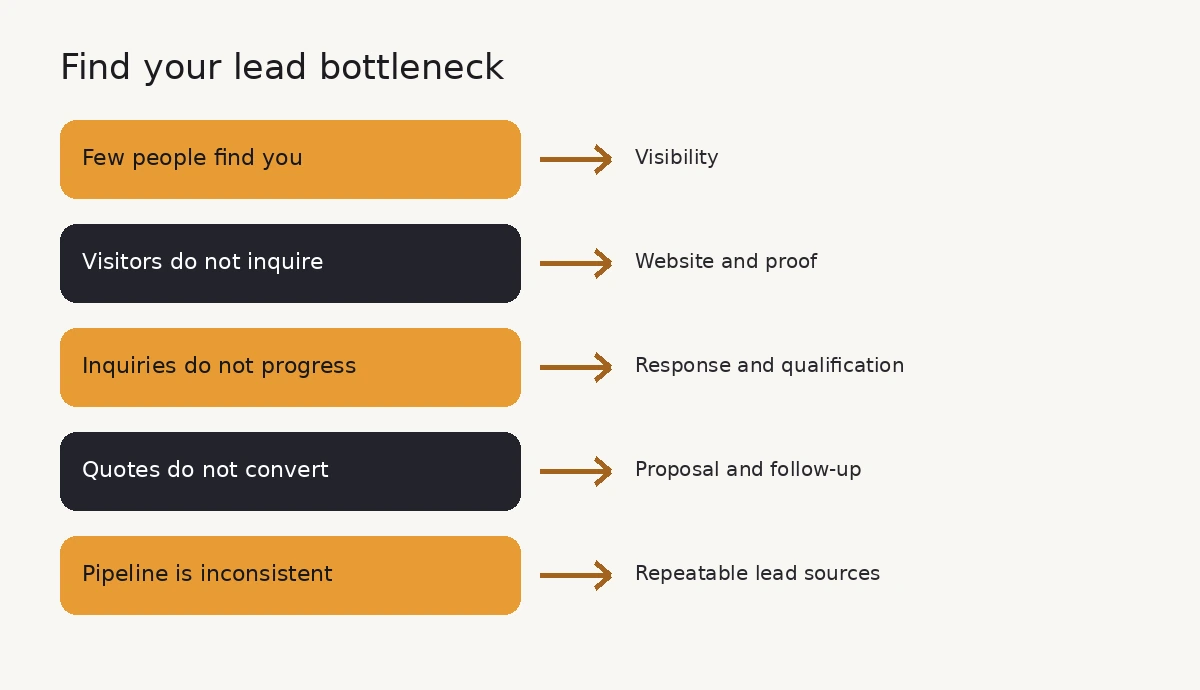
Before changing your strategy, identify where the system is breaking.
- If people aren't discovering you: focus on Google, local SEO, content, Pinterest, partnerships, and visibility.
- If people discover you but don't inquire: focus on website clarity, portfolio proof, reviews, service pages, and calls to action.
- If you're getting inquiries but few quotes: focus on response quality, qualification, communication, and the inquiry process.
- If you're sending quotes but not booking: focus on proposal quality, follow up, sales conversations, and removing uncertainty.
- If bookings happen but the pipeline is inconsistent: focus on repeatable lead sources, referrals, content, partnerships, and measurement.
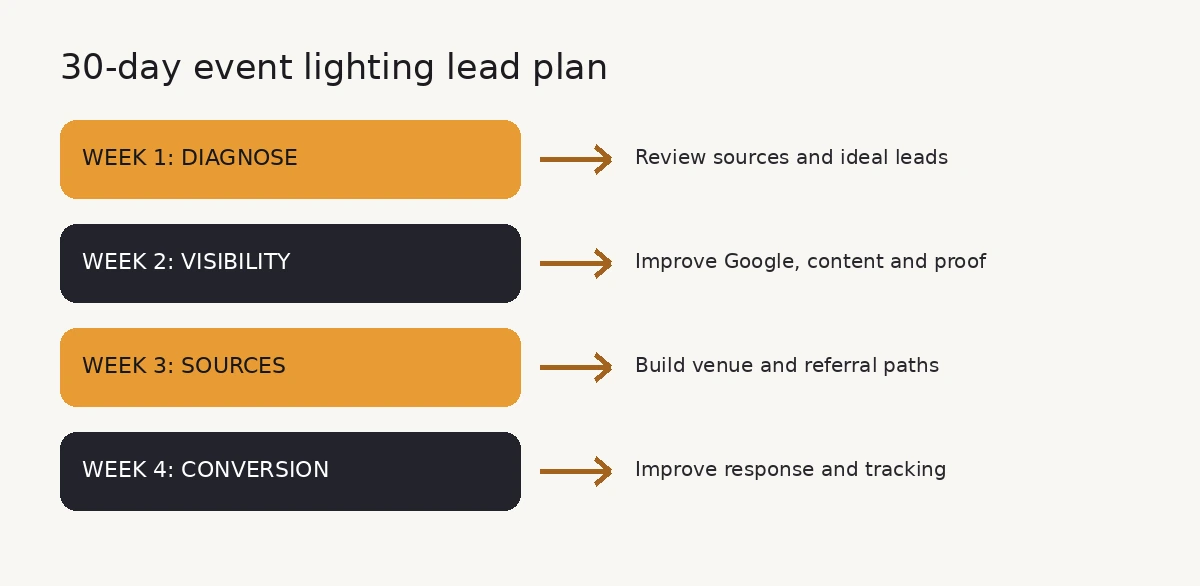
Your 30-Day Event Lighting Lead Plan
You don't need to rebuild your entire marketing system in a month. Start by strengthening the foundations.
Week 1 — Diagnose
- Review your last 20 to 30 leads.
- Identify your strongest sources.
- Identify your ideal lead types.
- Find your biggest lead generation bottleneck.
Week 2 — Strengthen Visibility
- Improve your Google Business Profile.
- Review important service and location pages.
- Add strong project examples.
- Identify 3 to 5 useful content topics.
Week 3 — Build Lead Sources
- Contact relevant venues and planners.
- Create one venue specific resource.
- Build a simple referral process.
- Repurpose one strong event into multiple marketing assets.
Week 4 — Improve Conversion
- Review your inquiry form.
- Improve your first response.
- Create a follow up sequence.
- Start tracking lead source to booking.
At the end of the month, you should have a clearer understanding of where your next leads should come from and where your current opportunities are being lost.
What Should You Work on First?
If your event lighting company needs more leads, don't automatically start by posting more content or running ads.
Start here:
- Find your current lead sources. Know where your best opportunities are coming from.
- Identify the bottleneck. Are you invisible, unconvincing, difficult to contact, slow to respond, or weak at follow up?
- Strengthen one or two lead sources. Don't spread your effort across ten channels.
- Turn successful projects into reusable marketing assets. Your past work is one of your strongest sources of proof.
- Track leads through booking. Otherwise, you won't know which marketing activities are actually producing business.
Frequently Asked Questions
How can I get more event lighting leads without spending a lot on advertising?
Start with assets you already have: completed projects, customer reviews, your Google Business Profile, your website, past inquiries, and existing industry relationships. These can create additional opportunities without requiring a large advertising budget.
What is the best source of event lighting leads?
There isn't one universal source. The strongest source depends on your market, customer type, location, reputation, and existing relationships. Track your leads through booking to identify which sources work best for your company.
How do I get more wedding lighting leads?
Focus on local search visibility, wedding specific portfolio content, venue relationships, planner referrals, visual platforms such as Pinterest, reviews, and wedding focused service pages.
How do event lighting companies get venue referrals?
Start by becoming useful to venues. Show how your lighting can improve their events, create venue specific resources, demonstrate previous work at similar spaces, and build a relationship before asking for referrals.
Should an event lighting company use paid advertising?
Paid advertising can be part of a lead generation system, but it should not replace strong fundamentals such as visibility, proof, website conversion, response, and follow up.
The LitBooked Takeaway
More event lighting leads don't come from doing more marketing for the sake of doing more marketing. They come from building a system where each part has a clear job:
GET FOUND → GET TRUSTED → GET INQUIRED → GET RESPONDED TO → GET FOLLOWED UP → GET BOOKED
Your Google presence creates discovery. Your projects, reviews, and content create trust. Your venues, planners, and referrals create additional opportunities. Your website turns interest into inquiries. And your response and follow up determine what happens next.
The goal is not simply to fill your inbox. It's to build a repeatable pipeline of qualified event lighting opportunities.
If you're not sure where your current lead generation system is breaking, a LitBooked Visibility Audit can help identify the gaps worth fixing first.
Get Your Free LitBooked Visibility Audit
Related Resources
- How to Market an Event Lighting Company
- Event Lighting Marketing Ideas
- Event Lighting Marketing Strategy
- How to Get More Event Lighting Bookings
- Event Lighting Marketing Funnel
- The Complete SEO Guide for Event Lighting Companies
- How to Get on Wedding Venue Preferred Vendor Lists
SEO Setup
- Primary Keyword: how to get more event lighting leads
- Secondary Topics: event lighting leads, event lighting lead generation, event lighting company leads, how to generate event lighting leads, event lighting marketing, event lighting referrals, event lighting website conversion
- Search Intent: Problem / Solution
- SEO Title: How to Get More Event Lighting Leads | LitBooked
- Meta Description: Learn how to get more event lighting leads through Google, content, venues, referrals, social media, website conversion, and follow up.
- URL: /how-to-get-more-event-lighting-leads/
- Commercial Destination: Event Lighting Lead Generation
- Primary CTA: Free LitBooked Visibility Audit